
Overview
State Unemployment Insurance (SUI) — or State Unemployment Tax Act (SUTA) — are payroll tax contributions that provide temporary wage continuation to an employee in the event they become unemployed through no fault of their own.
Contributions to SUI are made to the state in which the employee would expect to claim unemployments benefits, in the case that he or she becomes unemployed. This is often easy to determine, as commonly, employees live and work in a single state.
However, if an employee lives and works in more than one state, then the employer and the employee need to determine a single state to which they will contribute SUI taxes (i.e., the employee’s primary SUI state). To determine the employee’s primary SUI state, employers and employees should follow the ”Localization of Work” provisions published by the IRS, which includes factors like where the employee’s “base of operations” is, or where their services are “directed or controlled from”.
Once that choice has been made, OnTheClock allows employers to enter this information for each employee, and ensure that SUI taxes are only withheld in that primary state. This document will explain how to enter that information, and what effects to expect.
Using primary workplace
In OnTheClock, an employee’s primary SUI state is based on the state of that employee’s primary workplace.
Employees in OnTheClock are assigned workplaces, and one of those workplaces is designated as the employee’s primary workplace. If an employee is only assigned one workplace, then that workplace is automatically set as the employee’s primary workplace; otherwise, this selection needs to be made manually.
Because primary workplace serves this important purpose in tax calculations, it being undefined for an employee will put that employee in a blocking onboard status.
How are taxes affected by primary workplace?
While we’ve only talked about SUI taxes so far, there are actually several other tax types that follow the same Localization of Work provisions as SUI, and are affected in the same way as SUI by setting an employee’s primary workplace. These include:
- State Unemployment Insurance (SUI) taxes
- SUI “surcharge” taxes (e.g., California Employment Training Tax)
- Most State Disability Insurance (SDI) taxes
- Most Paid Family Medical Leave (PFML) taxes
- Most Worker’s Compensation (WC) taxes
- Pennsylvania Local Taxes
The full list of taxes that follow this behavior is listed at the bottom of this article.
For these taxes, they will only be included on a payroll item if that employee’s primary workplace is a workplace in that tax’s state, even if the employee earned wages in that state.
Other taxes such as income taxes will still be based on wages earned in each state, as well as other factors like reciprocity.
How do I change an employee’s primary workplace?
To view or change the primary workplace for an employee in Console, first navigate to that employee by clicking the Employees tab, scrolling down to Active Employees, and selecting the employee you wish to view.
Then on the Employee Info tab, scroll down to Workplaces. You should see an indicator next to the workplace that is the employee’s primary workplace. To change the primary workplace, hover over a workplace and select the “Make primary” option that appears.

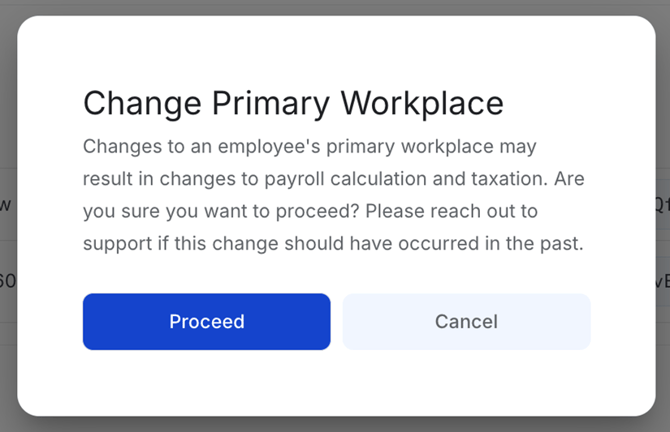
Finally, click “Proceed” in the confirmation modal to complete the change.
Are corrections required?
As mentioned in the above confirmation modal, changes to primary workplace that should have been effective dated in the past should be raised to OnTheClock Support to ensure that previously calculated payrolls are recalculated with the correct primary workplace. This is akin to changing the workplace at which an employee’s wages were earned on a previous payroll.
If the primary workplace change is only meant to be effective going forward, then a correction is not required. However, note that future payrolls may have SUI Taxable Wage Credits applied, as explained below.
SUI Taxable Wage Credits
When the primary workplace — and hence, the primary SUI state — is changed in the middle of the year, most state unemployment agencies allow for a taxable wage credit to be applied from the previous state to new state. This reduces the employer’s overall SUI tax burden for the new state.
For example, let’s say an employee has accumulated $5,000 in taxable wages for IL SUI, and then changes their primary workplace (and their primary SUI state) from IL to IN. That $5,000 will be applied as a credit towards IN SUI, which in 2024 has a wage base of $9,500. This means that the employee will only need an additional $4,500 in taxable wages for IN SUI, rather than the full $9,500.
Different state unemployment agencies may or may not recognize taxable wage credits from other states, or have different limits on the amount of credits that can be claimed. These rules are already incorporated in OnTheClock tax calculations, and SUI taxable wage credit will be calculated and applied automatically.
Taxes that follow localization of work
Below are all of the taxes that automatically follow localization of work provisions, and will be taxed based on the employee's primary workplace instead of where wages were earned.
Alabama Employment Security Assessment
Alabama State Unemployment Tax
Alaska State Unemployment Tax
Alaska SUI
Arizona State Unemployment Tax
Arkansas State Unemployment Tax
California Employment Training Tax
California SDI
California State Unemployment Tax
Colorado Paid Family and Medical Leave - Employee
Colorado Paid Family and Medical Leave - Employer
Colorado Solvency Surcharge
Colorado State Unemployment Tax
Colorado Support Surcharge
Connecticut Paid Leave
Connecticut State Unemployment Tax
DC Administrative Funding Tax
DC Paid Family Leave - Employer
Delaware State Unemployment Tax
Delaware Training Tax
District of Columbia State Unemployment Tax
Florida State Unemployment Tax
Georgia Administrative Assessment Tax
Georgia State Unemployment Tax
Hawaii Employment And Training Tax
Hawaii State Unemployment Tax
Idaho Administrative Reserve
Idaho State Unemployment Tax
Idaho Workforce Development
Illinois State Unemployment Tax
Indiana State Unemployment Tax
Iowa State Unemployment Tax
Kansas State Unemployment Tax
Kentucky Service Capacity Upgrade Fund Surcharge Tax
Kentucky State Unemployment Tax
Louisiana State Unemployment Tax
Maine CSSF Maine State Unemployment Tax
Maine UPAF
Maryland State Unemployment Tax
Massachusetts COVID-19 Recovery Assessment
Massachusetts Employer Medical Assistance Contributions
Massachusetts Paid Family and Medical Leave - Employee
Massachusetts Paid Family and Medical Leave - Employer
Massachusetts State Unemployment Tax
Massachusetts Workforce Training Fund
Michigan State Unemployment Tax
Minnesota State Unemployment Tax
Minnesota Workforce Development Fee
Mississippi State Unemployment Tax
Mississippi Workforce Training Enhancement
Missouri State Unemployment Tax
Montana Administrative Fund Tax
Montana State Unemployment Tax
Nebraska State Unemployment Tax
Nevada Career Enhancement Program
Nevada State Unemployment Tax
New Hampshire Administrative Contribution
New Hampshire State Unemployment Tax
New Jersey Employer SDI
New Jersey Family Leave Insurance
New Jersey SDI
New Jersey State Unemployment Tax
New Jersey SUI
New Mexico State Unemployment Tax
New York Reemployment Fund
New York State Unemployment Tax
NJ Work Force Development/Supplemental Work Force
North Carolina State Unemployment Tax
North Dakota State Unemployment Tax
Ohio State Unemployment Tax
Oklahoma State Unemployment Tax
Oklahoma Technology Fund
Oregon Paid Family and Medical Leave - Employee
Oregon Paid Family and Medical Leave - Employer
Oregon State Unemployment Tax
Pennsylvania State Unemployment Tax
Pennsylvania Local Services Taxes (LSTs)
Rhode Island Job Development Surcharge
Rhode Island SDI
Rhode Island State Unemployment Tax
South Carolina State Unemployment Tax
South Carolina SUI Admin Contingency Assessment Tax
South Dakota Administrative Fee
South Dakota Employer Investment Fee Tax
South Dakota State Unemployment Tax
Tennessee State Unemployment Tax
Texas State Unemployment Tax
Utah State Unemployment Tax
Vermont State Unemployment Tax
Virginia State Unemployment Tax
Washington Employment Administration Fund (EAF)
Washington Long-Term Care Insurance
Washington State Unemployment Tax
West Virginia State Unemployment Tax
Wisconsin State Unemployment Tax
Wyoming State Unemployment Tax