Salary to Hourly Calculator
See exactly how much you earn per day, week, month, and year with one quick calculation.
FTE Calculator
Full-Time Employees
Part-Time Employees
How to Use the Salary Calculator
If you’re trying to understand what you truly earn, this calculator gives you a clear answer without the guesswork. Follow these steps, and you’ll see your full pay breakdown in seconds.
Step 1: Enter Your Pay
Start by entering your wage if your pay changes based on the hours you work. Type the amount you earn per hour in the Hourly Rate box, or enter your total annual salary if you’re paid the same amount each year.
Step 2: Adjust Your Hours
Enter how many hours you work each week so the calculator reflects your actual schedule. The default is 40 hours, but you can change it to match your routine. If you work fewer hours, you can lower the number, and if you often work overtime, you can increase it. This step helps you see how different weekly schedules affect your overall pay.
Step 3: View Your Pay Breakdown
Look at the pay breakdown that updates as soon as you enter your information. This section shows what you earn per day, per week, every two weeks, and per month based on the numbers you provided. It gives you a clear, simple view of your income so you can understand how your pay adds up across different time periods.
Why People Use Salary to Hourly Convertors
It’s common to look at your salary and still feel unsure about what you actually earn for each hour you work. Most people don’t think about their hourly rate until something forces the question, maybe you’re comparing a new job offer, negotiating a raise, or trying to understand whether all those extra hours are cutting into the value of your paycheck. A salary number looks clean on paper, but it often hides the real story behind your time.
That uncertainty is usually what leads people to a salary to hourly convertor. You want a number that makes sense. You want something concrete you can use to check whether your pay matches the effort you put in.
A convertor also helps when your workload shifts. Maybe you’re salaried but working nights and weekends, and you’re starting to wonder if your hourly rate is dropping without you noticing. Or maybe your schedule is inconsistent, and you need a fair way to compare your time with your pay. Seeing your hourly rate laid out clearly gives you insight into whether your current rhythm works for you or whether something needs to change.
How Salary to Hourly Conversion Works
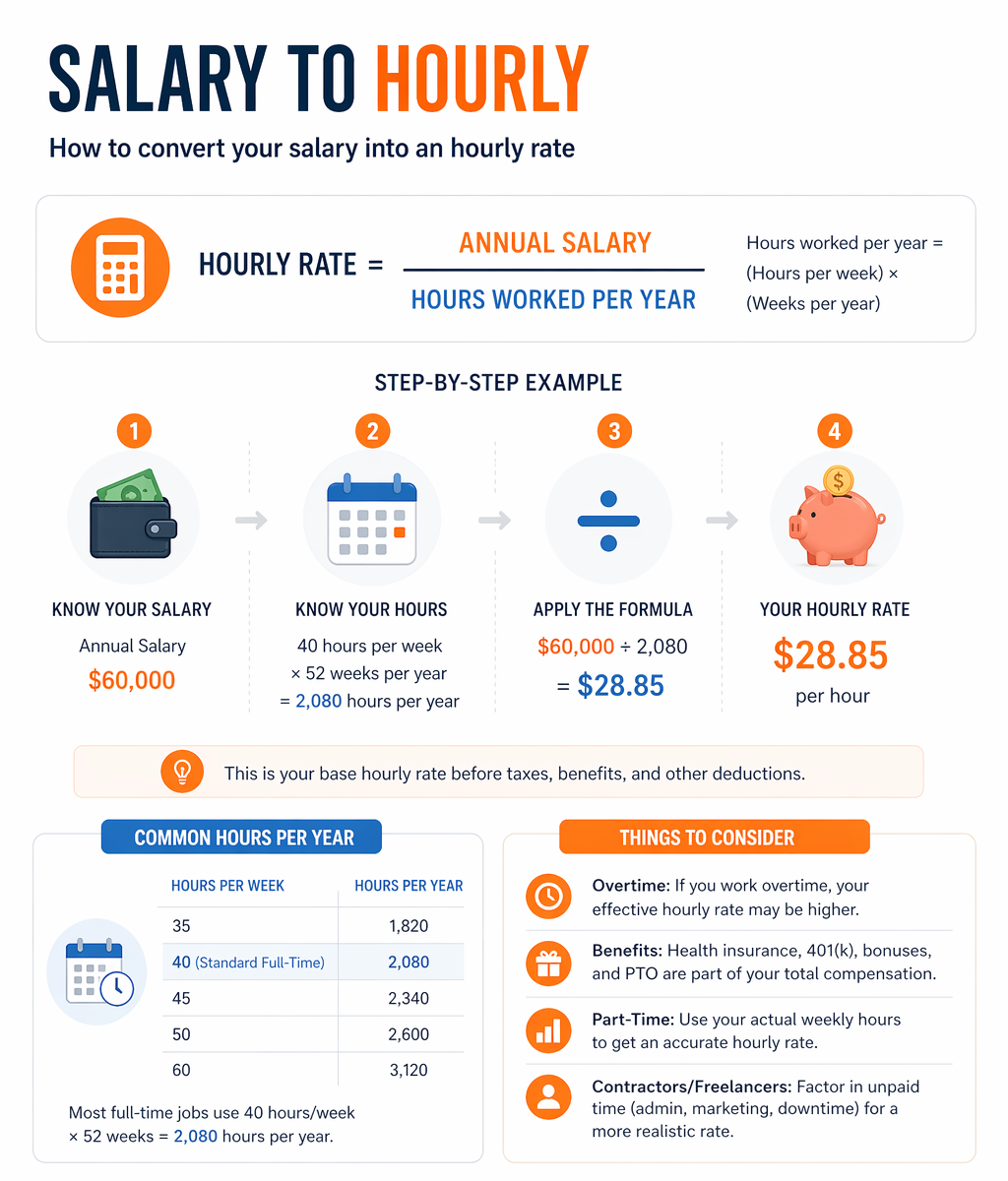
Before you run any numbers, it helps to understand the basic idea behind salary-to-hourly math. For example, two people may both earn $60,000 a year, but if one works 40 hours a week and the other regularly works 50, their true hourly rates are very different. A conversion isn’t random, it’s based on the number of hours you’re expected to work in a year. Most full-time salaries assume a 40-hour workweek, which adds up to 2,080 hours a year. But not everyone works that schedule, and that’s where confusion usually starts.
Your true hourly rate depends on three things:
- How many hours you work each week
- How many weeks you work each year
- Whether your schedule includes paid time off
If your actual hours are different from the standard 40-hour assumption, your effective hourly rate shifts with them. That’s why two people earning the same salary can walk away with very different hourly values, one might have a strict 40-hour week, while the other puts in 55 hours just to keep up.
When you understand the inputs behind the calculation, you gain control over the output. You can see how small changes in your schedule raise or lower your hourly rate, and you can compare jobs or offers in a way that feels fair and grounded.
The Formula to Convert Salary to an Hourly Rate
Once you understand the basics behind the calculation, the next step is turning your salary into a clear hourly number. The formulas are simple, and they work best when you use the actual number of hours you work each week. Here are the most common conversions people use to understand their true earning power.
Annual salary to hourly formula
The standard formula assumes a 40-hour week and 2,080 work hours per year:
Hourly rate = Annual salary ÷ 2,080
This gives you a baseline, but it only reflects your true hourly rate if you actually work 40 hours each week. If your schedule is different, your hourly rate will change along with your weekly hours.
Monthly salary to hourly formula
If you’re paid monthly, use this version:
Hourly rate = Monthly salary × 12 ÷ 2,080
This simply converts your monthly pay into an annual number before dividing by total work hours.
Weekly salary to hourly formula
Some roles offer a weekly salary instead of an annual one. For that setup, the formula is:
Hourly rate = Weekly salary ÷ Weekly hours worked
This version is the most flexible, because you can use any weekly hour total—40, 37.5, or a part-time schedule.
Example calculations for common schedules
Seeing the formulas in action makes the numbers easier to understand. Your hourly rate changes the moment your weekly hours shift, even if your salary stays the same. These examples show how different schedules influence the final hourly amount.
Full-time 40-hour examples
A 40-hour workweek is the standard most salary ranges are based on. That’s why the yearly hour total is 2,080.
Example 1: $52,000 salary
- 2,080 yearly hours
- $52,000 ÷ 2,080 = $25.00 per hour
Example 2: $75,000 salary
- 2,080 yearly hours
- $75,000 ÷ 2,080 = $36.06 per hour
These examples show how the standard calculation works when your weekly schedule doesn’t shift.
37.5-hour examples
Some organizations use a 37.5-hour workweek, especially in administrative, education, and office roles. This changes the yearly hours from 2,080 to 1,950.
Example 1: $52,000 salary
- 1,950 yearly hours
- $52,000 ÷ 1,950 = $26.67 per hour
Example 2: $75,000 salary
- 1,950 yearly hours
- $75,000 ÷ 1,950 = $38.46 per hour
When the total hours go down, the hourly rate goes up—even though the salary hasn’t changed.
Part-time examples
Part-time schedules vary the most, so your hourly rate depends heavily on your weekly hours.
Example 1: $30,000 salary at 30 hours/week
- 1,560 yearly hours
- $30,000 ÷ 1,560 = $19.23 per hour
Example 2: $28,000 salary at 25 hours/week
- 1,300 yearly hours
- $28,000 ÷ 1,300 = $21.54 per hour
Two people with similar salaries can end up with very different hourly rates because their weekly hours aren’t the same.
The Formula to Convert Hourly Pay to a Salary
In some cases, you’re starting from the opposite direction. Instead of a salary that needs to be broken down into an hourly rate, you already know your hourly pay and want to see what it equals on a yearly basis. This comes up when you’re comparing a potential promotion, looking at a full-time offer, or trying to understand what your hourly work would look like as a salary. The good news is that the calculation is simple once you know your weekly hours.
How hourly rate becomes an annual salary
The basic formula for converting hourly pay into a salary is:
Annual salary = Hourly rate × Weekly hours × 52
This formula assumes you work the same number of hours each week throughout the year. It gives you a clear picture of what your hourly rate looks like when stretched across a full year of work.
How weekly hours affect your final salary
Your weekly schedule has a major impact on the final number. Two people earning the same hourly rate can have very different annual salaries because one works more hours than the other.
Here’s how different weekly hour totals shift the yearly salary:
- 40 hours/week: Standard full-time salary estimate
- 37.5 hours/week: Common in administrative and office roles
- 30 hours/week or less: Typical part-time range
A small change in weekly hours adds up quickly over a year. If you often pick up overtime or have an inconsistent schedule, your annual salary can change even more.
Quick Conversion Tables
Sometimes you just want a fast way to compare numbers without running formulas. These quick-reference tables give you an instant view of common salary-to-hourly and hourly-to-salary conversions. They use a 40-hour workweek as the baseline, since that’s the most widely used standard for full-time pay.
Salary to hourly quick-reference table
| Annual Salary | Hourly Rate (40 hrs/week) |
|---|---|
| $35,000 | $16.83/hr |
| $40,000 | $19.23/hr |
| $45,000 | $21.63/hr |
| $50,000 | $24.04/hr |
| $55,000 | $26.44/hr |
| $60,000 | $28.85/hr |
| $65,000 | $31.25/hr |
| $70,000 | $33.65/hr |
| $75,000 | $36.06/hr |
| $80,000 | $38.46/hr |
These numbers help you quickly evaluate job offers, compare roles, or check whether your salary lines up with the time you put in.
Hourly to salary quick-reference table
| Hourly Rate | Annual Salary (40 hrs/week) |
|---|---|
| $15/hr | $31,200/year |
| $18/hr | $37,440/year |
| $20/hr | $41,600/year |
| $22/hr | $45,760/year |
| $25/hr | $52,000/year |
| $28/hr | $58,240/year |
| $30/hr | $62,400/year |
| $32/hr | $66,560/year |
| $35/hr | $72,800/year |
| $40/hr | $83,200/year |
This table gives you a clear look at what your hourly work is worth across a full year, assuming a consistent schedule.
Hourly Pay vs Monthly Salary
Each pay type shapes how your time is valued, and understanding this difference helps you compare job offers fairly. On the surface, a salary might look more stable, while an hourly rate feels more flexible. But the real difference shows up in how each structure handles your time, your workload, and your paid time off. When you break it down, both systems tell different stories about how you’re compensated.
How compensation differs by pay structure
With hourly pay, you’re compensated for every hour you work. If you work more, you earn more. If you work less, your pay goes down. This structure is straightforward, and it makes it easy to connect your time to your earnings.
With a monthly salary, your pay stays the same regardless of the hours you work. The company agrees to pay you a fixed amount each month based on an expected workload. This can feel predictable, but the hourly value of your salary changes if your workload shifts. Extra hours lower your effective hourly rate; fewer hours raise it.
The main difference comes down to visibility. Hourly pay makes the value of your time obvious. Salary assumes a level of stability that may or may not match your actual schedule.
How PTO affects salary vs hourly pay
Paid time off affects each pay type differently.
For salaried employees, PTO is already built into the compensation structure. You take a week off and your paycheck doesn’t change. That stability is one reason people like salaried roles—your income doesn’t drop when you rest or take care of personal needs.
For hourly employees, PTO depends on the employer. If your company offers paid sick time or vacation hours, you’ll be compensated while off. If not, time off directly reduces your paycheck. That makes PTO policies more important for hourly workers because the financial impact hits immediately.
So while salary often absorbs time off without much stress, hourly workers must plan for the hours they do or don’t get paid for.
Why monthly salary can mask real earnings
A monthly salary can look impressive on paper, but it doesn’t always show the full picture of your workload. If your job regularly stretches past the expected weekly hours, your hourly value declines without you realizing it.
For example, a $60,000 salary assumes a 40-hour workweek. But if you consistently work 50 hours a week, your actual hourly rate drops from $28.85 to $23.08. You may still feel well-paid because the monthly number seems solid, but your time is earning less than you think.
A monthly salary can also hide small changes that add up over time:
- Extra tasks outside your role
- Weekend work
- Nightly emails that become routine
- Seasonal spikes in workload
These hours don’t always get counted, and salary doesn’t adjust to match them.
Salary vs Hourly: The Trade-Offs
When you compare salary and hourly pay, it’s easy to assume one is better than the other. But the truth is that each option has benefits depending on your situation, your workload, and what you want your daily life to feel like. Understanding the trade-offs helps you figure out which structure supports your goals, not just your paycheck.
Advantages of hourly work
Hourly pay gives you a clear connection between your time and your earnings. Every hour you work adds to your paycheck, and you see the value of your effort immediately. If you work in a role where overtime is common, this structure can help you earn significantly more than a fixed salary.
Hourly work also gives you more financial flexibility. If your schedule changes, you can adjust your hours to fit your needs. And if you prefer boundaries, hourly compensation makes it easier to say, “My shift is over.” When your pay is tied directly to time, you’re less likely to feel pressure to work beyond what you’re compensated for.
For many people, hourly pay also brings control. You can track your hours, monitor your income, and make decisions based on real numbers instead of assumptions. If transparency matters to you, hourly work offers that naturally.
Advantages of salaried work
A salary provides stability. You know exactly what you’ll earn each paycheck, no matter what your weekly schedule looks like. That consistency makes budgeting easier and removes the stress of fluctuating hours or unpredictable shifts.
Salaried roles often come with benefits that support long-term growth: paid time off, health coverage, retirement contributions, and opportunities for advancement. These perks can make the entire compensation package more valuable than the base salary alone.
Salary also gives you breathing room when life gets busy. If you need a sick day or take time away for personal reasons, your pay doesn’t disappear. And in many roles, a salary reflects a level of trust and responsibility that goes beyond hourly tasks.
If you like stability, long-term career paths, or predictable paychecks, a salary may feel more aligned with how you want to work and live.
How Your Paycheck Changes After Conversion
Once you convert your pay, the next question is usually the same: What does this mean for my actual paycheck? Seeing your hourly rate or salary on paper is helpful, but it doesn’t tell the full story of what ends up in your bank account. Your gross pay, your taxes, and your deductions all shape the final number you live on. Understanding these pieces gives you clarity and helps you plan with confidence.
Gross pay vs net pay explained
Your gross pay is the amount you earn before any deductions.
If you’re hourly, it’s your hourly rate multiplied by your hours worked.
If you’re salaried, it’s your salary broken into each pay period.
Your net pay is what you actually take home. This is the number that matters for your day-to-day life because it reflects the money available for bills, savings, and goals.
The difference between the two can feel confusing at first, especially if your pay structure changes. A conversion helps you understand your hourly value, but comparing gross to net shows you the impact of taxes and deductions. When you know both numbers, you see a more accurate picture of your financial reality.
How taxes impact the real hourly rate
Taxes influence your paycheck more than most people expect. Your take-home pay can change depending on:
- Your tax bracket
- How often you get paid
- Your deductions (insurance, retirement, etc.)
- Whether your hours fluctuate
- Whether overtime applies
If you're hourly and pick up extra shifts, your gross pay rises. But your net pay might not jump as much as you think because additional income may be taxed at a higher rate.
If you're salaried, your hourly value may shift even more. Working extra hours lowers your effective hourly rate, but your taxes stay the same based on your annual salary. This can make your paycheck feel smaller compared to the effort you’re putting in.
Seeing how taxes influence your real hourly rate helps you understand whether your pay structure works for you or if it’s time to look for something more balanced.
Salary Range and Competitiveness
Once you know your true hourly rate, it helps to understand how that number compares to the broader job market. A quick comparison gives you context, reveals whether your compensation aligns with industry expectations, and helps you decide if your current role is supporting your financial goals. This is where people often have their biggest “aha” moment. A number that looked fine on paper can feel very different when you compare it to market ranges or similar roles in your field. This section helps you make sense of where you stand and whether your pay reflects your skills, experience, and workload.
Checking if your hourly rate is competitive
A conversion gives you the number—but competitiveness comes from context. To see whether your hourly rate matches the market, start by asking a few simple questions:
- Are people in similar roles earning more for the same hours?
- Does your hourly rate fall inside the common range for your industry?
- Does your pay reflect your experience and responsibilities?
- Has your workload increased without your pay adjusting?
If your hourly rate is far below market benchmarks, it may be a sign that you’re undervalued. On the other hand, if your rate falls on the higher side, you have leverage when negotiating or considering new opportunities.
The goal is to understand whether your compensation aligns with the work you’re doing today—not the work you were doing years ago.
Market examples for common roles
Seeing real numbers helps you put your own pay in perspective. Here are simple, widely referenced hourly ranges for typical full-time roles, based on national averages:
- Administrative Assistant: $18–$25 per hour
- Customer Support Specialist: $17–$22 per hour
- Skilled Trades (electrician, plumber, HVAC): $25–$40+ per hour
- Medical Assistant: $18–$26 per hour
- Bookkeeper: $20–$32 per hour
- Project Coordinator: $22–$32 per hour
- Software Support or IT Helpdesk: $22–$30 per hour
These ranges show how roles with similar workloads can have very different pay structures. When your converted hourly rate lines up with or exceeds these benchmarks, you know your compensation is competitive. If it doesn’t, you have clear evidence to bring into a negotiation or job search.
How to compare offers accurately
Comparing job offers can be stressful, especially when one lists a salary and the other lists an hourly rate. A conversion levels the playing field so you can compare them fairly.
Here’s the simplest way to do it:
- Convert everything to an hourly rate or an annual salary
Use the formulas or tables in this guide to get an apples-to-apples comparison. - Factor in expected weekly hours
A higher salary doesn’t always mean better pay if the job regularly demands 50–55 hours a week. - Check PTO, benefits, and holidays
Two jobs with the same hourly rate can feel very different if one pays for time off and the other doesn’t. - Look at commute, schedule, and flexibility
Sometimes the highest-paying job isn’t the one that improves your life. - Use a paycheck calculator for take-home estimates
This helps you see the real difference after taxes and deductions.
When you break an offer down to its hourly value, you remove the guesswork. You can choose the option that respects your time, supports your goals, and gives you the financial clarity you need.
FAQ
For most full-time roles, the formula looks like this:
Hourly rate = Annual salary ÷ 2,080
This assumes a 40-hour workweek and 52 weeks per year. If you work fewer or more hours each week, adjust the total yearly hours to match your actual schedule. Using your real hours gives you a more accurate hourly rate.
That number comes from:
- 40 hours per week
- 52 weeks per year
However, not every job follows this structure. Some employers use 37.5-hour weeks, which equals 1,950 hours per year. Part-time roles use fewer hours, depending on the schedule. Always use the hours you actually work to get an accurate conversion.
Annual salary = Hourly rate × Weekly hours × 52
For example:
- $25/hour at 40 hours/week = $52,000 per year
- $30/hour at 40 hours/week = $62,400 per year
- $25/hour at 37.5 hours/week = $48,750 per year
The same hourly rate can lead to very different salaries depending on weekly hours.
Hourly pay is often better if:
- You work overtime
- You want clear boundaries around your time
- Your schedule changes often
- You want predictable pay
- You receive strong benefits and paid time off
- Your workload stays close to expected hours
The best option is the one that pays fairly for the time you actually work.
However, your take-home pay can feel different:
- Hourly workers may see more variation due to overtime or fluctuating hours
- Salaried workers may work extra ho
Using a paycheck calculator helps you understand how taxes, deductions, and hours worked affect what you actually take home.