Key Takeaways
- ✔Poor employee adoption is the No. 1 sign your time tracking software isn't working. If your team avoids using it, you're losing money on manual corrections and missing data.
- ✔Support quality matters more than features. Real human support that responds quickly prevents payroll disasters and saves hours of admin time.
- ✔You're likely overpaying for unused features. Most small businesses need accurate tracking, PTO management, scheduling, and payroll integration, not enterprise analytics.
- ✔Manual payroll integration is costing you. Every export/import/reformat step introduces errors and wastes time that direct integration eliminates.
- ✔Switching is easier than staying. The temporary effort of migrating (typically a few hours) eliminates ongoing daily frustrations and inefficiencies.
Let's cut to the chase: You're probably here because your current time tracking software or tool is driving you nuts. Maybe it's the constant crashes. Maybe it's the support tickets that go unanswered for days. Or maybe, and this is the big one, you're just tired of paying too much for features you never use while the basics still don't work right.
Here's the thing: Staying with time tracking software that doesn't work isn't just frustrating; it's costing you money. Real money. Between wasted admin hours, payroll errors, and employee frustration, a bad time tracking system can drain thousands from your bottom line every year.
So, when is it actually time to make the switch? And, more importantly, how do you know you're not just jumping from the frying pan into the fire?
The Red Flags that Scream "It's Time to Switch"
Your Team Actually Hates Using it
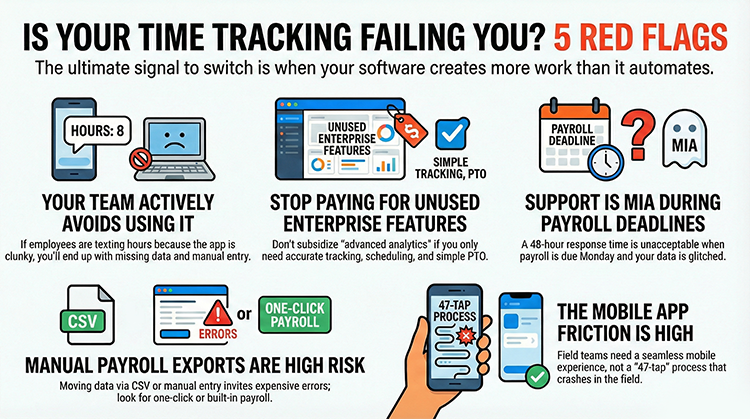
If you're constantly nagging employees to clock in, or if they're texting you their hours because "the app won't work again," you've got a problem. Good time tracking software should be invisible. Employees shouldn't even think about it.
When your team actively avoids using your time clock, you end up with:
- Missing punch data that turns payroll into detective work;
- Manual time entres that defeat the entire purpose; and
- Employees who feel like you don't trust them (because you're constantly following up).
The best time tracking software? It's almost invisible, because it just works.
You're Paying for Features You Never Use
Did you get sold on "workforce analytics" and "advanced scheduling algorithms" that sounded impressive in the demo? But, now you're three months in, you've never once opened those features?
This is the classic enterprise software trap. Big platforms load up on features to justify premium pricing, but most small businesses just need the basics done well:
- Accurate time tracking
- Simple PTO management
- Easy scheduling
- Clean payroll integration (or, better yet, built-in payroll)
If you're paying for bells and whistles you'll never use, you're subsidizing features for enterprise customers while getting stuck with their complexity.
Support Is MIA When You Need it Most
Picture this: It's Friday at 4 p.m., and payroll runs Monday morning. Your time tracking system just glitched and wiped half of your employees' hours.
You submit a support ticket.
You get an auto-reply saying they'll respond in 24-48 hours.
It's now Monday. Still nothing. You're manually reconstructing hours from memory and text messages.
Sound familiar?
Here's what you should expect instead: actual human beings who answer the phone; support that treats your payroll deadline like the emergency it is; people who fix problems instead of escalating tickets into the void.
The Price Keeps Creeping Up
You signed up at $X per month. Then, they added additional fees. Then they restructured pricing tiers. Now, you're paying 40% more than you did last year for the same exact tool/service.
When time tracking companies get acquired or chase growth, existing customers become cash cows to milk. They know switching is a pain, so they slowly ratchet up prices, betting you won't leave.
But here's the truth: Switching is way less painful than you think (more on that in a minute).
It Doesn't Talk to Your Payroll Software
If you're exporting time sheets to CSV, reformatting them in Excel, and manually entering hours into your payroll system, you're doing it wrong.
A proper integration means:
- One-click export from time tracking to payroll
- No reformatting, no manual entry, no room for error
- Hours that flow through automatically and accurately
Every manual step is a chance for mistakes. And payroll mistakes aren't just annoying; they're expensive, and they destroy employee trust.
If you're not in love with your payroll software, a better option for you might be to explore time clock software with built-in payroll. OnTheClock’s optional payroll tool allows you to directly pay your team based on their timecards with just a few clicks. No integrations, reformatting data, or opportunities for manual error.
The Mobile Experience Is Terrible
If your company is like most SMBs, your team isn't sitting at desks all day. They're in the field, on job sites, or running between locations. They benefit greatly from the ability to clock in from their phones.
If your mobile app is clunky, crashes constantly, or requires 47 taps to do something simple, you're creating friction exactly where you can't afford it.
Modern time tracking should work seamlessly on mobile, because that's where most of your team actually uses it.
What to Look for in Your Next Time Clock
When you're ready to switch, don't make the same mistakes that got you here. Here's what actually matters:
Simplicity Over Features
Choose software that does the core functions exceptionally well instead of doing 100 things poorly. You need accurate time tracking, straightforward PTO management, and reliable payroll integration. Everything else is gravy.
Transparent, Fair Pricing
Look for companies that charge based on actual value, not how much they can extract. No surprise fees, forced upgrades, or pricing gymnastics.
Real Human Support
Test support before you commit. Call them, email them, and see how fast they respond and whether they actually solve problems. This matters more than any feature list.
Built for Small Businesses
Enterprise software built for Fortune 500 companies isn't going to work for small businesses. You need software designed around how you actually operate. Not configured, not customized, but fundamentally built for businesses like yours.
Modern, Mobile-First Design
Your employees should be able to clock in with one tap, from anywhere, on any device. If the mobile experience isn't dead simple, keep looking.
Why Switching Is Easier Than You Think
The biggest reason businesses stay with terrible time tracking software? They think switching will be a nightmare.
Here's the reality: if your current system is causing problems, you're already living in the nightmare. Switching takes just a few hours, and, subsequently, the problems you're dealing with every single day will be solved.
Most modern time tracking systems can:
- Import your employee data directly
- Get you up and running in an afternoon
- Provide hands-on help with migration
The temporary pain of switching is nothing compared to the ongoing misery caused by software that doesn't work.
The Bottom Line
You don't need to tolerate time tracking software that makes your job harder. You don't need to pay for features you'll never use. And you definitely don't need to deal with support that doesn't support anything.
If your current time clock is checking any of the red flag boxes above, it's time to make a change.
OnTheClock was built specifically for small businesses tired of overpaying for overcomplicated software. We keep it simple, affordable, and actually answer the phone when you need help. No contracts, forced upgrades, or surprise fees. Just honest time tracking that works.
Start your free trial and see what time tracking should actually feel like. Get set up in minutes, not weeks. And if you have questions? Real humans will actually answer.
Because your time tracking software should make your life easier, not harder.