

Jump to section
Try OnTheClock Free
Save time and make payroll effortless with our easy-to-use, affordable employee time tracking app.
Try It FreeBusiness owners know what payroll costs on paper: wages, taxes, and maybe a software subscription. What doesn't show up in the budget are the hours spent double-checking a time sheet, the worry about whether a rate was entered correctly, or the awkward conversation if a paycheck lands short.
To see just how deep those costs run, we surveyed more than 500 small and mid-sized business owners and payroll decision-makers. The results show how the type of training someone receives relates to payroll error rates, why fixing mistakes costs more than just money, and why leaders are eager to lean on AI to handle pay day, with one critical catch.
Key Takeaways
- 65% of respondents are comfortable letting AI handle parts of payroll, but there's no consensus on who's responsible if it makes a mistake.
- Paying someone the wrong amount is the most common payroll mistake at 41%, followed by miscalculated taxes (21%), late payments (18%), and missed payments (14%)
- Time is the most common cost of payroll errors. Among those asked, 45% say a payroll error cost them time in the past 12 months, compared with 30% who lost money.
- Respondents who were taught by a predecessor are more likely to report their company has made payroll mistakes than those trained through any other method.
With Hours of Payroll to Do Each Pay Period, 68% of SMB Owners, CEOs Are Open to AI's Help
Payroll isn't a task most small business leaders hand off. Among the CEOs, founders, and owners we polled, 68% say they handle payroll themselves day-to-day, the highest share of any role we surveyed.
Half of these leaders said payroll takes them three hours or more to complete each pay period. One in 10 say the same tasks take them six or more hours. For a company running biweekly payroll, three to five hours a period adds up to roughly two to three full workweeks. At six hours or more, that's closer to four weeks.
| Time on Payroll Per Pay Period | % of CEOs, Founders, Owners | Time Spent on Payroll Per Year |
|---|---|---|
| 3-5 hours | 50% | 2–3 workweeks |
| 6+ hours | 10% | ~4 workweeks |
The time it takes to complete these tasks isn't the only cost for SMB leaders. The majority (83%) could name at least one part of payroll they find stressful. This includes keeping up with tax and compliance rules (31%), calculating overtime or hourly rates correctly (17%), and catching time sheet errors before payday (14%).
We found that worry outlasts the actual work, with 40% of small business owners, CEOs, or founders calling payroll accuracy a major concern they think about constantly.
Given how much time owners spend on payroll themselves, it makes sense that they're open to handing off some of those tasks.
When we asked SMB owners, founders, and CEOs how they felt about AI-powered automation taking on payroll tasks, 68% felt positively about it. Just 15% were hesitant or against it. That sentiment tracks with all the experts we surveyed: 64% feel positively about AI taking on payroll tasks.
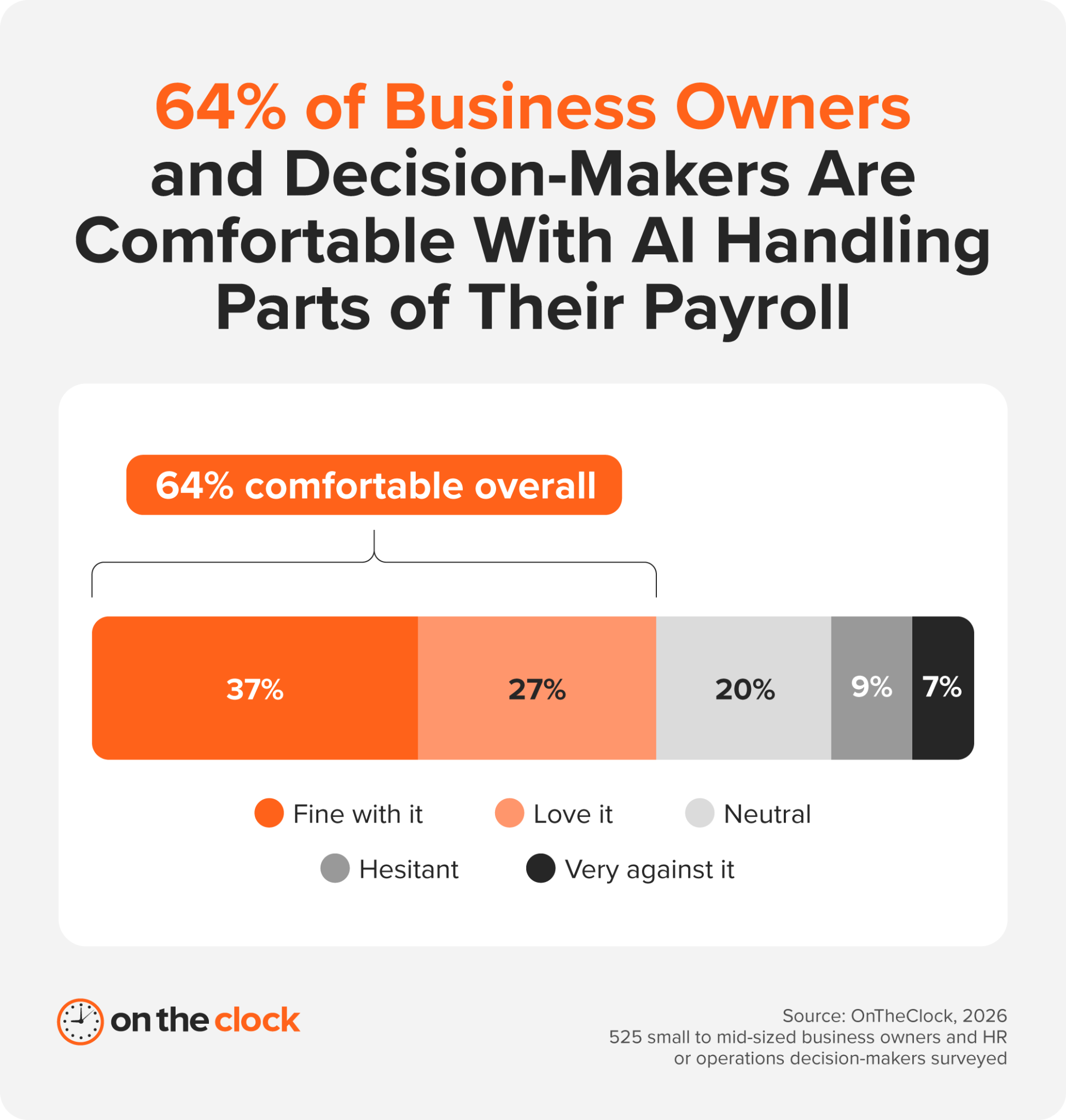
But only 11% of owners would let AI handle their payroll today
Openness isn't the same as readiness, though. Only 11% of owners, CEOs, or founders say they're fine with letting AI handle their payroll today. Here's what they say they need to feel more comfortable letting AI support payroll:
- The ability to review payroll before it's submitted: 50%
- A financial guarantee from the provider if it makes an error: 40%
- Proof that similar businesses use the AI tool successfully: 35%
- A recommendation from someone they trust: 30%
- Legal review or compliance certification: 30%
The Stakes of Misusing AI Are High: 63% of SMBs Have Already Made a Payroll Mistake
Payroll errors rarely look like a full system crash. They're usually just small enough to slip by unless someone is looking for them. For SMBs, these slips occur more often than not: 63% of owners and payroll handlers say their companies have made payroll errors.
Paying someone the wrong amount is the most common slip-up at 41%, nearly double the next issue on the list. Miscalculated or misfiled payroll taxes follow at 21%, along with late payments (18%) and completely missed payments (14%).
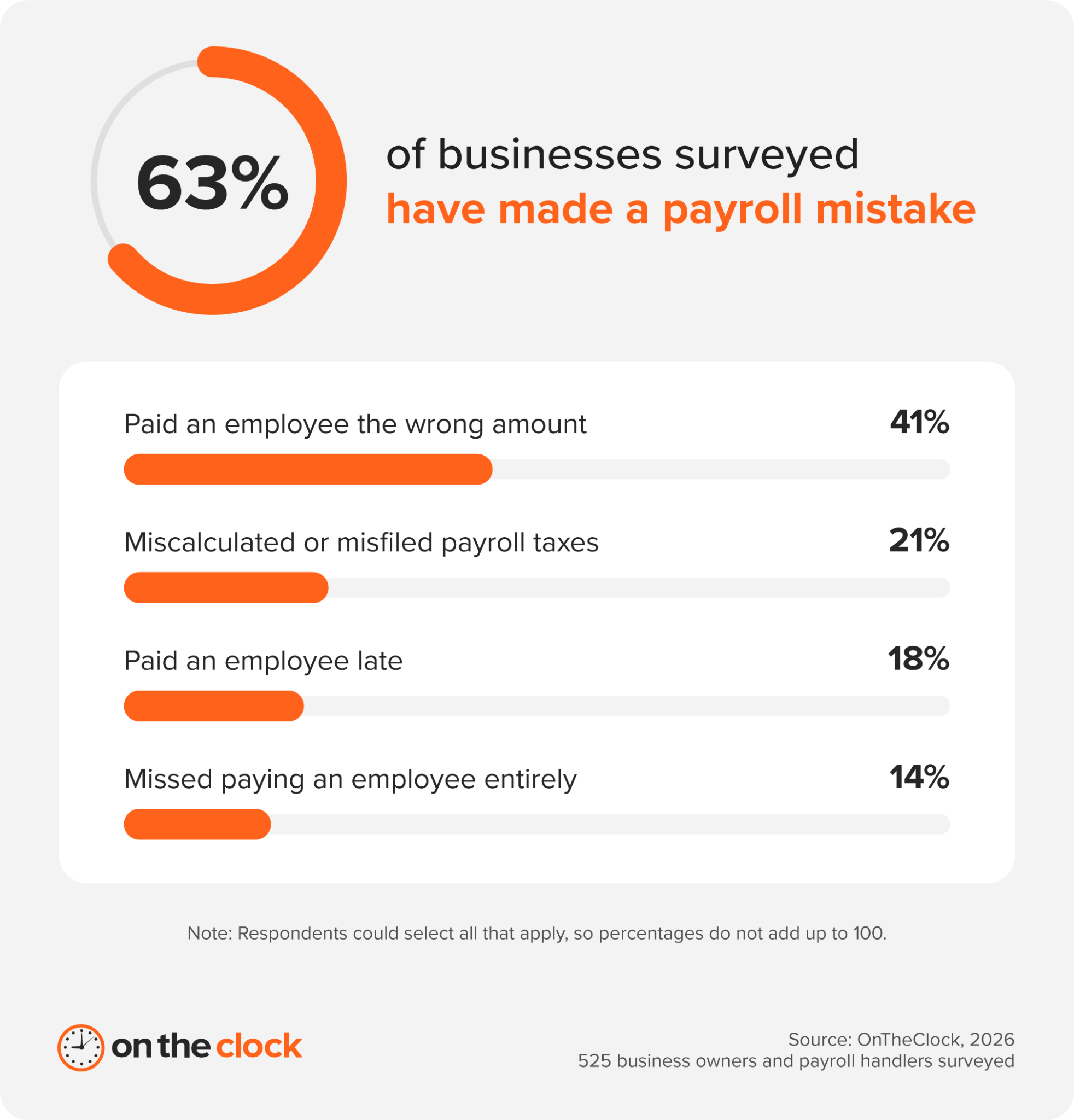
Crucially, payroll can only be as accurate as the time sheets it starts with—meaning our 63% mistake rate only reflects the errors employers actually caught. The real number could be even higher.
If SMB owners are going to use AI, they want assurance that it will be 100% accurate. If it isn't, owners could take the blame. Overall, these are the three main culprits respondents identified when AI makes a payroll error:
- The AI or software company: 50%
- The manager overseeing payroll: 33%
- The business owner: 25%
However, when you look at job titles, business owners, CEOs, and founders are far harsher on themselves than their teams are. Thirty-eight percent say the business owner is ultimately responsible for AI's payroll mistakes. By comparison, only 19% of HR leaders and 15% of operations leaders feel the same.
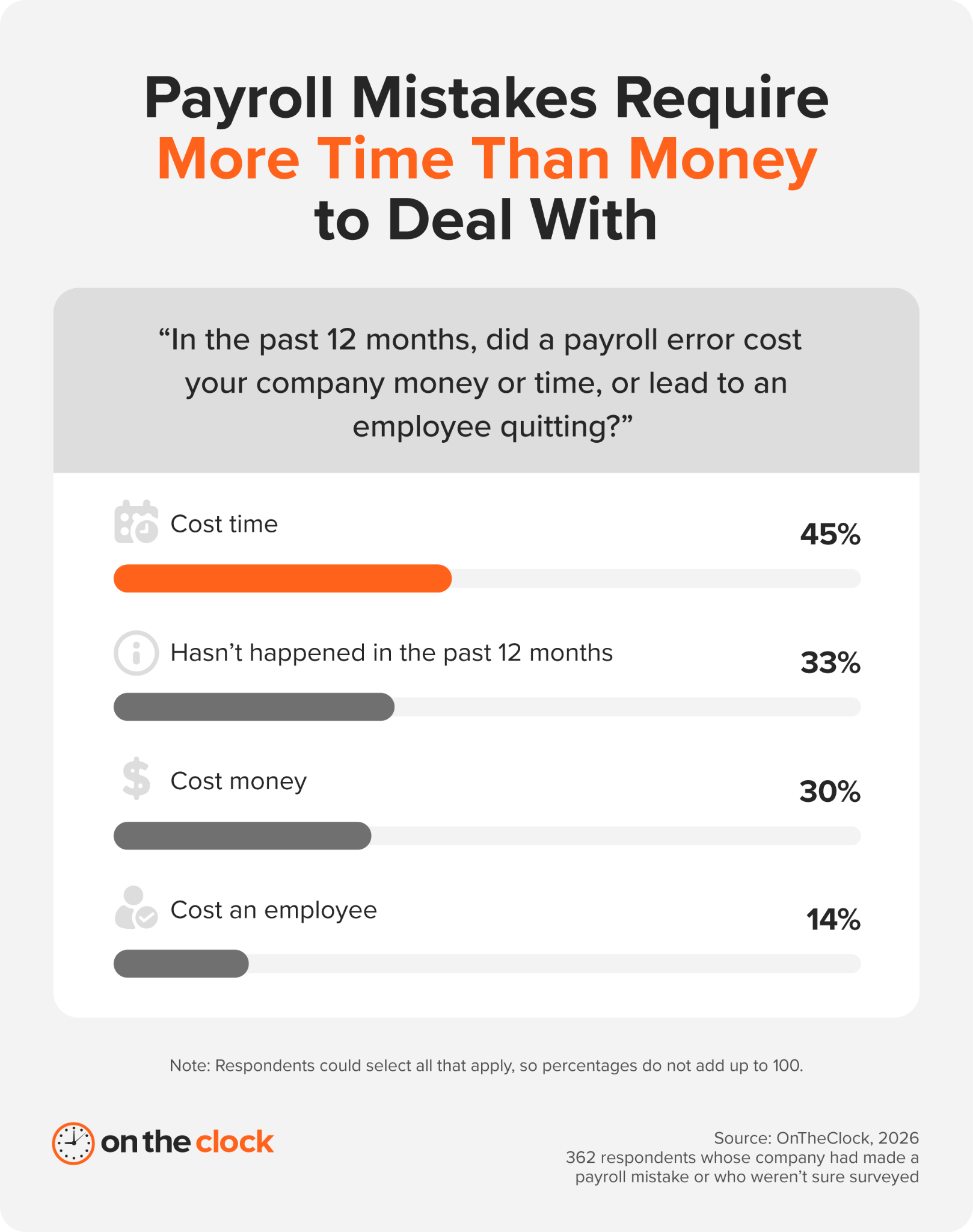
When these discrepancies do come to light, our new data shows the fallout can be costly. Among respondents whose company made a payroll error, 45% say it cost them time, and 30% lost money due to reimbursements or tax penalties. Another 14% saw an employee resign over the issue.
The Training Method That Leads to the Fewest Payroll Mistakes
If you want to reduce payroll errors, look at how your team learns. Formal training and certification yield the lowest mistake rates across the board.
More than one-third (35%) of professionals with formal training reported their company has never made a payroll mistake—the highest rate in the study. By contrast, error rates climb steadily as training becomes more informal:
- Formal training or certification: 65% reported mistakes, 35% were error-free.
- Trial and error on the job: 72% reported mistakes, 28% were error-free.
- Self-taught via online resources: 73% reported mistakes, 27% were error-free.
- Taught by a predecessor: 76% reported mistakes, 24% were error-free.
Teams relying on informal training saw nearly half (49%) pay an employee the wrong amount and 21% miss a payment entirely (compared to 41% and 14% overall).
While many professionals rely on a mix of learning methods, supplementing informal mentorship with structured training and certification can help break inherited bad habits and protect payroll accuracy.
Accepting the responsibility of using AI for payroll means proactive prevention can't be an afterthought. To avoid taking the fall for preventable errors, companies need guardrails built directly into their workflow.
Tips for a Bullet-Proof Payday: Checkpoints, Training, and Smart Tech
Between juggling multiple timecards, informal training, and software settings, payroll rarely breaks down in just one place. Stopping mistakes takes a clear, proactive strategy long before payday arrives.
Here are a few payroll best practices SMBs can use to protect their time and bottom line.
Standardize training instead of handing off informal notes: Being great at running payroll doesn't automatically make someone a great teacher. Passing down tasks informally transfers habits without the reasoning behind them, leading to errors when unusual time sheets pop up. Standardize your onboarding with clear documentation, HR-led training, and trusted third-party courses or webinars.
Keep a human in the loop with AI: Automation should speed up your workflow, not run on total autopilot. Software notifies the team of anomalies but lets managers inspect, adjust, and approve final numbers before submission.
Build intentional checkpoints into your process: Mistakes happen when work is pushed through a conveyor belt without any quality assurance. Build in at least one dedicated review stop before funds are released. If you only have time to inspect one item, check the final pay amounts. That's the area where most things go off track.
Time-tracking tools like OnTheClock build these safeguards directly into the workflow, flagging questionable hours and rate calculations before they turn into time-sucking headaches down the road.
Methodology
The survey was conducted online by Centiment with a total sample size of 525 small to mid-sized U.S. business owners and HR or operations decision-makers. Each was required to have direct, hands-on responsibility for reviewing/approving employee time sheets and payroll, as well as between two and 250 hourly employees whose hours are self-reported, rather than fully salaried office staff.
Fieldwork was undertaken from Aug. 15-21, 2026. Data are unweighted, and the margin of error is approximately ±4% for the overall sample at a 95% confidence level.