

Jump to section
Try OnTheClock Free
Save time and make payroll effortless with our easy-to-use, affordable employee time tracking app.
Try It FreeKey Takeaways
- ✔Form 944 is for small employers the IRS has approved to file annually instead of filing Form 941 every quarter.
- ✔Employers that owe $1,000 or less in annual employment taxes generally qualify. As a rule of thumb, that usually means paying $5,000 or less in wages subject to Social Security, Medicare, and federal income tax withholding.
- ✔The 2026 Form 944 is due Feb. 1, 2027. Employers that made all required deposits on time and in full generally have until Feb. 10, 2027.
- ✔If your annual tax liability is less than $2,500, you may generally pay it when you file Form 944. Higher liabilities may require deposits during the year.
- ✔You cannot switch between Form 944 and Form 941 on your own. You must request the change and wait for written IRS approval.
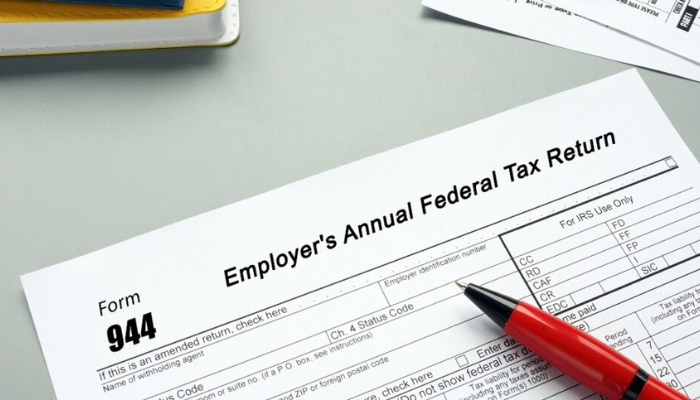
Form 944 is the Employer’s Annual Federal Tax Return for employers who owe $1,000 or less each year in Social Security, Medicare, and withheld federal income taxes. You should only file Form 944 if the IRS tells you in writing that you need to. For the 2026 tax year, the return is due Feb. 1, 2027.
As a small business owner, you already have plenty to manage. So, getting an IRS notice telling you to file a different payroll tax form can be confusing. Why are you filing Form 944 instead of Form 941? What information do you need? And how do you file it correctly?
Keep reading. We’ll explain what Form 944 is, who needs to file it, and what you need to know before you get started.
What Is IRS Form 944?
IRS Form 944, officially called the Employer’s Annual Federal Tax Return, is designed for small employers that owe $1,000 or less each year in Social Security, Medicare, and withheld federal income taxes. Instead of filing Form 941 every quarter, eligible employers file Form 944 once a year.
As a general rule, the IRS says employers who pay $5,000 or less in wages subject to Social Security, Medicare, and federal income tax withholding will usually owe $1,000 or less in employment taxes for the year. However, you should only file Form 944 if the IRS has notified you in writing that you qualify or has approved your request to switch from Form 941.
Form 944 helps employers report federal income tax withholding and Federal Insurance Contributions Act (FICA) taxes, which include Social Security and Medicare taxes. In 2026, the Social Security tax rate is 6.2% for both the employer and employee on wages up to $184,500. Medicare is 1.45% for both sides and has no wage limit. Employers must also withhold an additional 0.9% Medicare tax from an employee’s wages above $200,000.
You’ll use Form 944 to report information such as:
-
Employee wages and tips
-
Federal income tax withheld
-
Employer and employee shares of Social Security and Medicare taxes
-
Adjustments to Social Security and Medicare taxes, when applicable
Eligible small businesses can also claim the qualified small business payroll tax credit for increasing research activities. The credit is reported on line 8 of Form 944, and you must attach Form 8974 if you claim it.
Who Must File Form 944?
The most important Form 944 filing requirement is simple: You can only file Form 944 if the IRS tells you to do so in writing. Employers who have not received approval to file Form 944 should generally continue filing Form 941 each quarter. See the IRS Instructions for Form 944 for the full filing rules.
Form 944 is designed for small employers that expect to owe $1,000 or less in Social Security, Medicare, and withheld federal income taxes for the year. If you’re a new employer and expect to meet this limit, you can indicate that on Form SS-4 when applying for an employer identification number (EIN).
If you currently file Form 941 but believe you meet the Form 944 filing requirements, you can ask the IRS for permission to switch. You must continue filing Form 941 until the IRS sends written confirmation that your filing requirement has changed.
The same rule applies if your business grows. If the IRS has told you to file Form 944, you must continue filing it even if your annual employment tax liability rises above $1,000. You can switch to Form 941 only after requesting the change and receiving approval from the IRS.
There are also a few exceptions. You cannot file Form 944 if:
-
You employ only household employees. These taxes are generally reported on Schedule H.
-
You employ only agricultural workers. These taxes are generally reported on Form 943.
-
The IRS has told you to file Form 941 instead.
-
You have not received IRS approval to file Form 944.
Ultimately, who files Form 944 is determined by the IRS, not simply by whether your tax liability is below $1,000.
How to Request Form 944, or Switch Back to Form 941
You cannot switch between Form 941 and Form 944 on your own. You must ask the IRS for permission and wait for written confirmation before changing which form you file.
If you currently file Form 941 and expect to owe $1,000 or less in employment taxes for the year, you can request to file Form 944 instead. If you currently file Form 944, you can also ask the IRS to switch you back to quarterly Form 941.
To change your filing requirement for a given year, call the IRS at 800-829-4933 between Jan. 1 and April 1 of that year, or send a written request postmarked between Jan. 1 and mid-March. For 2026, the mail deadline was March 16. Check the current Form 944 instructions for the exact dates before you request a change for 2027.
If you mail your request, send it to one of these addresses:
Department of the Treasury
Internal Revenue Service
Ogden, UT 84201-0038
or
Department of the Treasury
Internal Revenue Service
Cincinnati, OH 45999-0038
Use the Ogden address if that is where you would normally mail your return without a payment. If your no-payment return would go to Kansas City, send your request to the Cincinnati address instead.
After you make the request, wait for the IRS to send written confirmation that your filing requirement has changed. Until you receive that notice, keep filing the form you are currently required to use.
Form 944 vs. Form 941
The main difference between Form 944 and Form 941 is how often you file. Form 941 is filed four times a year, while Form 944 is filed once a year. Both forms report federal income tax withholding, Social Security taxes, and Medicare taxes.
Another key difference is that you do not choose between the two forms on your own. The IRS determines which form you should file.
| Form 941 | Form 944 | |
|---|---|---|
| Filing frequency | Quarterly | Annually |
| Who files | Employers | Employers |
| Who decides | Generally the default filing requirement unless the IRS approves Form 944 | The IRS must notify or approve you to file it |
| Eligibility | Most employers that withhold federal income, Social Security, or Medicare taxes | Generally small employers with annual employment tax liability of $1,000 or less who have IRS approval |
| Due dates | April 30, July 31, Oct. 31, and Jan. 31 | Generally Jan. 31 of the following year |
| Deposit rules | If your tax liability is less than $2,500 for the current or prior quarter, you may generally pay with the return. Otherwise, monthly or semiweekly deposit rules may apply. | If your yearly liability is less than $2,500, you may generally pay with the return. Higher liabilities may require quarterly, monthly, or semiweekly deposits. |
| Correction form | Form 941-X | Form 944-X |
Form 940 is a separate annual return for federal unemployment (FUTA) tax. See our guide on how to file Form 940.
How to Fill Out Form 944, Step by Step
Filing Form 944 may seem complicated at first, but the form is easier to manage when you take it one section at a time. Before you begin, gather your payroll records for the year so you can report your wages, taxes, deposits, and credits accurately.
Step 1: Gather the Necessary Information
Before filling out Form 944, make sure you have:
- Business information: Your employer identification number (EIN), legal business name, trade name, and address.
- Employee wage information: Total wages, tips, and other compensation paid during the year.
- Tax information: Federal income tax withheld, Social Security wages and tips, Medicare wages and tips, and Additional Medicare Tax withholding.
- Deposit records: Any federal payroll tax deposits you made during the year.
- Credit information: Records needed to claim the qualified small business payroll tax credit for increasing research activities, if applicable.
If you use payroll software, such as OnTheClock Payroll, much of this information should already be available in your payroll records.
Step 2: Enter Your Business Information
At the top of Form 944, enter your EIN, legal business name, trade name if you use one, and business address.
Make sure this information matches IRS records. If you do not have an EIN yet, you will need to apply for one through the IRS before filing Form 944.
Step 3: Complete Part 1 – Calculate Your Employment Taxes
Part 1 is where you report wages, withholding, Social Security and Medicare taxes, credits, deposits, and any balance due or overpayment.
Here is what goes on each line:
- Line 1: Enter the total wages, tips, and other compensation you paid employees during the year.
- Line 2: Enter the total federal income tax you withheld from employees’ wages, tips, and other compensation.
- Line 3: Check this box only if none of the wages, tips, or other compensation you paid are subject to Social Security or Medicare taxes. If you check it, skip line 4 and move to line 5.
- Lines 4a–4e: Report taxable Social Security wages, Social Security tips, Medicare wages and tips, and wages subject to Additional Medicare Tax withholding. Line 4e adds these Social Security and Medicare taxes together.
- Line 5: Add the federal income tax from line 2 to the Social Security and Medicare taxes from line 4e.
- Line 6: Enter any current-year adjustments, such as certain fractions-of-cents or sick-pay adjustments that apply to your business.
- Line 7: Combine lines 5 and 6 to calculate your total taxes after adjustments.
- Line 8: Enter any qualified small business payroll tax credit for increasing research activities. If you claim this credit, you must attach Form 8974.
- Line 9: Subtract line 8 from line 7 to calculate your total tax liability for the year.
- Line 10: Enter the total deposits you made for the year, including qualifying overpayments applied from earlier returns.
- Line 11: If line 9 is more than line 10, enter the difference as your balance due.
- Lines 12a–12e: If line 10 is more than line 9, report the overpayment. You can choose to apply it to your next return or request a refund. Starting with the 2025 form, you can have your refund direct deposited by entering your routing number, account type, and account number.
For line-by-line details, see the IRS Instructions for Form 944.
Step 4: Complete Part 2 – Report Your Tax Liability
Part 2 tells the IRS when your employment tax liability occurred during the year.
If line 9 is less than $2,500, check the first box on line 13 and move to Part 3.
If line 9 is $2,500 or more and you’re a monthly schedule depositor, report your tax liability for each month on lines 13a–13m.
If you’re a semiweekly schedule depositor, do not enter monthly amounts on lines 13a–13m. Instead, check the box on line 13 and attach Form 945-A, Annual Record of Federal Tax Liability.
Remember, Part 2 reports when the tax liability arose. It does not report when you made your deposits.
Step 5: Complete Part 3 – Report Whether Your Business Closed
If your business closed or stopped paying wages during the year, check the box in Part 3 and enter the final date you paid wages.
If your business is still operating and paying employees, leave this section blank.
Step 6: Complete Part 4 – Choose a Third-Party Designee
Part 4 lets you give another person permission to speak with the IRS about your Form 944.
For example, you may authorize your CPA, tax preparer, payroll provider, or another trusted person. If you choose “Yes,” enter the person’s name, phone number, and five-digit personal identification number (PIN).
If you do not want to authorize anyone, check “No.”
Step 7: Complete Part 5 – Sign and Date the Form
Review Form 944 carefully before signing it. Your signature confirms that the information on the return is true, correct, and complete to the best of your knowledge.
Who can sign depends on how your business is structured. An authorized signer may include:
- A sole proprietor or business owner
- A corporate president, vice president, or other authorized officer
- A partner or authorized member of a partnership
- An authorized member or manager of an LLC
- A fiduciary for a trust or estate
Enter the signer’s name, title, phone number, signature, and date before filing the return.
Deposit Rules for Form 944 Filers
Filing Form 944 once a year does not always mean you can wait until the end of the year to pay your employment taxes. Your deposit schedule depends on how much tax liability you build up during the year.
| Tax liability | Deposit requirement |
|---|---|
| Less than $2,500 for the year | You generally do not need to make deposits. You can pay the tax when you file Form 944. |
| $2,500 or more for the year, but less than $2,500 for a quarter | Deposit by the last day of the month after the quarter ends. If your fourth-quarter liability is less than $2,500, you may pay that amount with Form 944. |
| $2,500 or more for a quarter | You must follow the monthly or semiweekly deposit schedule that applies to your business. |
There are two numbers that are easy to confuse: $1,000 and $2,500.
The $1,000 threshold helps determine whether an employer may qualify to file Form 944. The $2,500 threshold determines whether a Form 944 filer may pay with the return or must make tax deposits during the year. These are separate rules.
For example, the IRS may have instructed you to file Form 944 because you originally expected to owe $1,000 or less. If your business grows and your tax liability later reaches $3,000, you may still be required to file Form 944. However, you may now have to make deposits during the year instead of paying everything when you file.
If you are required to make federal tax deposits, they must be made electronically. You can use the Electronic Federal Tax Payment System (EFTPS), an IRS business tax account, or another IRS-approved electronic payment method.
Employers that reach $2,500 or more in liability for a quarter must follow either a monthly or semiweekly deposit schedule based on their IRS lookback period. If you accumulate $100,000 or more in tax liability on any single day, the IRS generally requires a deposit by the next business day. See the IRS employment tax deposit rules for more details.
When Is Form 944 Due?
Form 944 is generally due by Jan. 31 of the following year. If Jan. 31 falls on a weekend or legal holiday, the deadline moves to the next business day.
For the 2025 tax year, Form 944 was due Feb. 2, 2026, because Jan. 31 fell on a Saturday. For the 2026 tax year, Form 944 is due Monday, Feb. 1, 2027, because Jan. 31 falls on a Sunday.
If you made all required deposits on time and in full, you generally have until Feb. 10, 2027, to file your 2026 Form 944.
You can file employment tax returns electronically through approved tax software or an authorized IRS e-file provider. You can also mail a paper return. If you file electronically, don't also mail a paper return.
Where Do You Mail Form 944?
If you file a paper Form 944, the mailing address depends on where your business is located and whether you include a payment. The IRS maintains the current Form 944 mailing addresses.
| Where your business is located | Without a payment | With a payment |
|---|---|---|
| Connecticut, Delaware, District of Columbia, Georgia, Illinois, Indiana, Kentucky, Maine, Maryland, Massachusetts, Michigan, New Hampshire, New Jersey, New York, North Carolina, Ohio, Pennsylvania, Rhode Island, South Carolina, Tennessee, Vermont, Virginia, West Virginia, Wisconsin | Department of the Treasury Internal Revenue Service Kansas City, MO 64999-0044 |
Internal Revenue Service P.O. Box 932100 Louisville, KY 40293-2100 |
| Alabama, Alaska, Arizona, Arkansas, California, Colorado, Florida, Hawaii, Idaho, Iowa, Kansas, Louisiana, Minnesota, Mississippi, Missouri, Montana, Nebraska, Nevada, New Mexico, North Dakota, Oklahoma, Oregon, South Dakota, Texas, Utah, Washington, Wyoming | Department of the Treasury Internal Revenue Service Ogden, UT 84201-0044 |
Internal Revenue Service P.O. Box 932100 Louisville, KY 40293-2100 |
| No legal residence or principal place of business in any state | Internal Revenue Service P.O. Box 409101 Ogden, UT 84409 |
Internal Revenue Service P.O. Box 932100 Louisville, KY 40293-2100 |
| Exempt organizations; federal, state, and local government entities; and Indian tribal government entities | Department of the Treasury Internal Revenue Service Ogden, UT 84201-0044 |
Internal Revenue Service P.O. Box 932100 Louisville, KY 40293-2100 |
If you pay your balance electronically, by EFT, credit card, or debit card, mail your return to the "without a payment" address. Include Form 944-V only if you pay by check or money order.
The IRS can change filing addresses, so check the current Form 944 filing instructions before mailing your return.
Form 944 Penalties
Filing Form 944 late or failing to deposit payroll taxes on time can lead to IRS penalties and interest. The amount depends on what went wrong and how long the payment or return is late.
If you file Form 944 after the deadline, the failure-to-file penalty is generally 5% of the unpaid tax for each month or part of a month the return is late, up to a maximum of 25%.
Late payroll tax deposits follow a different penalty schedule:
| How late is the deposit? | Penalty |
|---|---|
| 1–5 calendar days | 2% |
| 6–15 calendar days | 5% |
| More than 15 calendar days | 10% |
| More than 10 days after the first IRS notice, or after an immediate-payment notice | 15% |
These percentages apply to the amount you failed to deposit. They do not stack. For example, a deposit that is more than 15 days late generally receives a 10% penalty, not 2% + 5% + 10%.
If you were required to make deposits but paid the tax with Form 944 instead, the IRS generally treats it as a late deposit and charges a 10% penalty. Paying late can also trigger a separate failure-to-pay penalty of 0.5% of the unpaid tax per month, up to 25%.
The IRS can also charge interest on unpaid taxes and penalties. Interest continues to grow until the balance is paid in full.
Trust Fund Recovery Penalty
Payroll taxes you withhold from employees are considered trust fund taxes because you collect them on behalf of the federal government.
If these taxes are not withheld, deposited, or paid to the IRS, the Trust Fund Recovery Penalty may apply. This penalty can equal 100% of the unpaid trust fund taxes. The IRS may assess it personally against people who were responsible for collecting or paying the taxes and willfully failed to do so.
Can Form 944 Penalties Be Removed?
In some cases, yes. The IRS may reduce or remove certain penalties if you can show reasonable cause and that you acted in good faith. Examples may include a natural disaster, serious illness, inability to access important records, or certain system problems that prevented you from filing or paying on time.
If the IRS has already assessed a penalty or interest charge, you can request an abatement using Form 843. If you receive an IRS penalty notice, you can also reply to the notice and explain why you believe you qualify for reasonable-cause relief. Do not include a penalty-abatement request with your original Form 944.
How to Correct Form 944
Even organized businesses can make mistakes when filing Form 944. Common errors include:
- Reporting the wrong wage or tax amounts
- Miscalculating Social Security, Medicare, or withheld federal income taxes
- Filing late
- Using the wrong employer identification number (EIN)
- Forgetting to sign the return
- Reporting totals that do not match your Forms W-2 and W-3
If you discover an error after filing, use Form 944-X, Adjusted Employer’s Annual Federal Tax Return or Claim for Refund. Explain what was wrong, enter the corrected amounts, and provide any required calculations or supporting information.
File Form 944-X separately. Don't file a second Form 944. Because the IRS matches your Form 944 totals against your Forms W-2 and W-3, correct any affected W-2s too.
If the correction shows that you underpaid employment taxes, pay the amount due as soon as possible to reduce additional interest and penalties. Payments can be made electronically through the Electronic Federal Tax Payment System (EFTPS) or your IRS business tax account.
Form 944 FAQs
Do I Have to File Form 944 if I Have No Employees?
Yes, if the IRS has told you to file Form 944, you generally still need to file it even if you had no employees or paid no wages during the year. Enter zeros where required.
If your business permanently closed or stopped paying wages, check line 14 and enter the date you last paid wages. See the Form 944 instructions for details.
What Happens if My Liability Goes Over $1,000?
You do not automatically switch to Form 941. If the IRS told you to file Form 944, continue filing it until the IRS approves a change.
However, a higher tax liability may change when you need to make deposits during the year.
Can I Choose to File Form 941 Instead?
Not on your own. If the IRS requires you to file Form 944, you must continue using it until you request a change and receive written approval from the IRS.
When Is Form 944 Due in 2027?
The 2026 Form 944 is due Feb. 1, 2027, because Jan. 31 falls on a Sunday.
If you made all required deposits on time and in full, you generally have until Feb. 10, 2027, to file.
The normal deadline is Jan. 31 of the following year, moving to the next business day when it falls on a weekend or legal holiday.
Where Do I Mail Form 944 With a Payment?
Form 944 returns mailed with a payment generally go to:
Internal Revenue Service
P.O. Box 932100
Louisville, KY 40293-2100
Check the current IRS Form 944 mailing addresses before sending your return because addresses can change.
Can I E-File Form 944?
Yes. Form 944 can be filed electronically using approved tax software or through an authorized IRS e-file provider. If you e-file, don't also mail a paper copy.
What Is Form 944-V?
Form 944-V is the payment voucher included with Form 944. You use it when sending an eligible payment by check or money order with a paper Form 944.
It is not part of the tax return itself and should not be used for federal tax deposits that are required to be made electronically.