

Jump to section
Close the Month With Real Hours
OnTheClock gives you approved time sheet hours for any date range, so your month-end accrual starts with real numbers instead of estimates. Track hours, overtime and PTO balances in one place, and send approved hours straight to payroll.
Try it Free!Key Takeaways
- ✔Accrued payroll includes wages and employer payroll costs earned but unpaid at month-end, recorded as a current liability.
- ✔Accrual accounting records payroll expenses when employees earn them, keeping labor costs in the correct reporting period.
- ✔Calculate accrued payroll by adding unpaid wages, employer payroll taxes, benefit costs, and earned bonuses or commissions.
- ✔Unused PTO belongs in a separate accrued vacation liability account rather than the month-end payroll accrual.
- ✔Reversing payroll accruals before recording regular payroll helps prevent the same wages from being counted twice.
What Is Accrued Payroll?
Accrued payroll is the wages, salaries, and employer payroll costs employees have earned but you haven't paid yet as of a reporting date, usually the last day of the month. You record it as a current liability under accrual accounting, and it clears when the next payroll runs.
Under accrual accounting, you record expenses when they're incurred, not when you pay them. Payroll rarely lines up neatly with the end of the month, so there's almost always a gap.
Say your biweekly pay period runs from Monday, Sept. 21, through Friday, Oct. 2, and payday is Oct. 9. Eight of the 10 workdays fall in September. By the time you close the books for September, employees have already earned eight days of wages that haven't been processed or paid. Those wages, plus the employer payroll taxes on them, are your accrued payroll for September.
Accrued payroll vs. payroll payable: Accrued pay has been earned but not yet run through payroll. Payroll payable is the pay you've already processed and will send out on payday. Both are liabilities, but they come from different points in the payroll cycle.
Why it matters: Booking accrued payroll matches labor costs to the month the work happened, so your monthly profit isn't overstated in one month and understated in the next. It also shows you what you'll owe on the next payday, so the payroll withdrawal never catches you short on cash.
Is accrued payroll an asset? No. It's a current liability, money you owe employees and tax agencies within the year.
Types of Accrued Payroll
Salaries and Wages
This is usually the largest piece: The gross pay employees have earned for days worked since the last processed payroll. It covers regular hours, salaried pay, and overtime pay for nonexempt employees.
Bonuses and Commissions
Bonuses and commissions are accrued in the period they're earned, even if you pay them quarterly or once a year. A sales commission earned on a September deal belongs in September's accrued payroll, even if it goes out in October. A year-end bonus you expect to pay should be accrued a little at a time throughout the year, not all at once in December.
Paid Time Off (PTO): A Related Liability
Earned but unused vacation and PTO is a related liability, but it isn't part of the month-end payroll accrual. PTO builds up over months and is paid out on a different schedule, so it's tracked separately in an Accrued Vacation Liability account. Some states also require payout of unused vacation when an employee leaves. To see what employees have earned, use the PTO calculator.
Payroll Taxes
There are two kinds of payroll tax liabilities, and they belong in different accounts:
- Employer payroll taxes are your business's own cost, and they make up accrued payroll taxes. That includes employer Social Security and Medicare (FICA) at 7.65% of wages, federal unemployment tax (FUTA), and state unemployment tax (SUTA). FUTA and SUTA only apply up to each employee's annual wage base, so they often drop to zero later in the year.
- Employee withholdings are the income tax and employee FICA you take out of paychecks. That money belongs to employees and tax agencies, so it is deposited into a separate withholding-payable account when payroll runs. It isn't an extra expense for your business. Learn more about payroll tax vs. income tax.
Employee Benefits
This covers employer-paid benefit costs that have been earned but not yet paid, such as your share of health insurance premiums, retirement plan contributions, and other benefits tied to the period.
Accrued Payroll vs. Cash Accounting
Accrued payroll only exists under accrual accounting. With cash accounting, you record wages when you pay them, so a September payroll paid in October is an October expense. Accrual accounting records wages when employees earn them, which is why September's unpaid days get booked in September.
| Accounting method | When wages are recorded |
|---|---|
| Cash accounting | On payday, when cash leaves the account |
| Accrual accounting | When employees earn them, even if payday is next month |
Many small businesses use cash accounting because it's simpler. You need accrual accounting if you prepare financial statements under generally accepted accounting principles (GAAP), which lenders and investors often require. For taxes, C corporations generally must use accrual if their average annual gross receipts over the prior three years exceed $32 million (the threshold for tax years beginning in 2026).
How to Calculate Accrued Payroll
At month-end, you're only accruing the days employees have worked since the last payroll you processed. Here's how to calculate it in four steps.
- Find the unpaid days. Count the workdays between the end of your last processed pay period and your reporting date, usually the last day of the month.
- Calculate wages for those days.
- Hourly employees: Multiply approved time sheet hours for those days by each employee's hourly rate. Add overtime at 1.5 times the regular rate for nonexempt employees who worked more than 40 hours in a workweek.
- Salaried employees: Divide annual salary by 260 workdays to get a daily rate, then multiply by the number of unpaid days.
- Add employer payroll taxes and benefits. Apply employer FICA (7.65%), plus FUTA and SUTA if the employee hasn't reached the annual wage base yet. Add any employer benefit contributions tied to those wages.
- Add earned bonuses and commissions. Include any bonuses or commissions employees earned in the period, even if you won't pay them until later.
Accrued payroll = unpaid wages + employer payroll taxes + employer benefit costs + earned bonuses and commissions
Keep unused PTO out of this calculation. It belongs in its own accrued vacation liability.
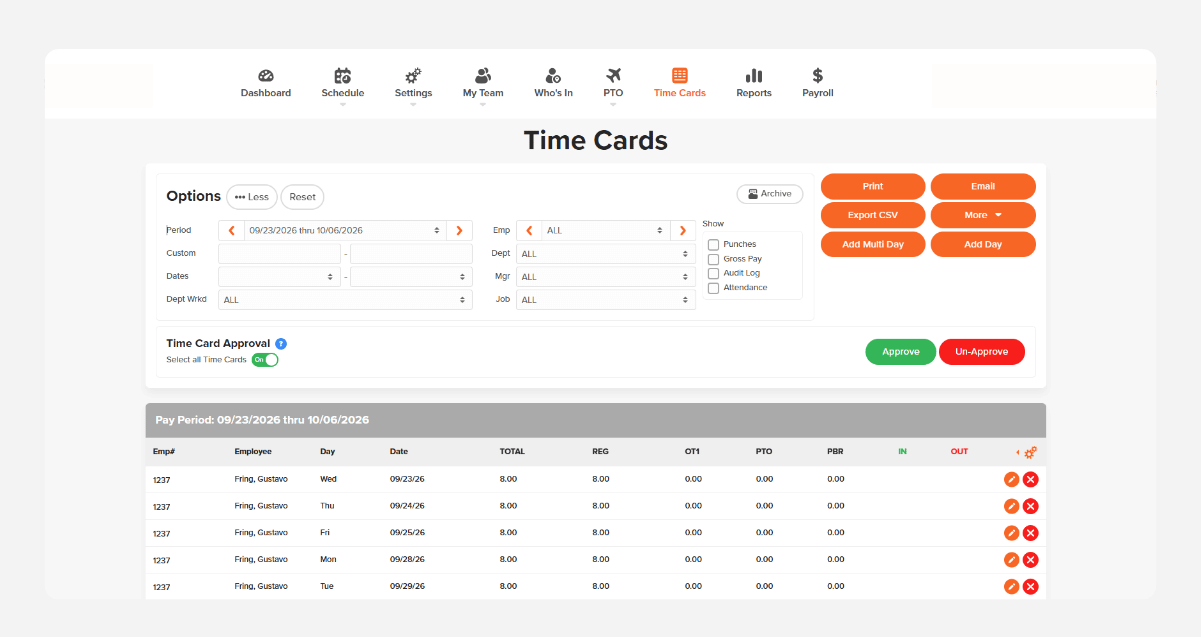
The hardest part is usually Step 2. If hours live on paper timecards, you're estimating. With OnTheClock time tracking, approved time sheet hours for any date range are already in the system, so you can pull exact hours instead of guessing.
Accrued Payroll Calculation Example
A small business runs a biweekly payroll. The current pay period runs from Monday, Sept. 21, through Friday, Oct. 2, and payday is Oct. 9. Eight of the 10 workdays fall in September, so to close the month, the business accrues payroll for those eight days. The hourly employee works 8 hours a day at $25 an hour, and the salaried employee's daily rate is $60,000 divided by 260 workdays. Wages are rounded to the nearest cent.
| Employee | Unpaid days | Wages | Employer FICA (7.65%) | Accrued total |
|---|---|---|---|---|
| Hourly ($25/hour, 8 hours/day) | 8 | $1,600.00 | $122.40 | $1,722.40 |
| Salaried ($60,000/year) | 8 | $1,846.15 | $141.23 | $1,987.38 |
| Total | $3,446.15 | $263.63 | $3,709.78 |
The business records $3,709.78 of accrued payroll at the end of September: $3,446.15 in accrued wages and $263.63 in employer payroll taxes. When the full payroll runs on Oct. 9, that liability is cleared. The next section shows the journal entries.
To keep the example simple, it leaves out FUTA, SUTA, benefits, and bonuses. In practice, add them for any employee who hasn't reached the wage base, and for any benefits or bonuses earned in the period.
Accrued Payroll Journal Entry
Recording accrued payroll takes three entries: the month-end accrual, a reversal on the first day of the next month, and the regular payday entry. Here's how they look using the example above.
| Account | Debit | Credit |
|---|---|---|
| 1. Sept. 30: Month-end accrual | ||
| Wage Expense | 3,446.15 | |
| Payroll Tax Expense | 263.63 | |
| Accrued Wages Payable | 3,446.15 | |
| Accrued Payroll Taxes Payable | 263.63 | |
| 2. Oct. 1: Reversing entry | ||
| Accrued Wages Payable | 3,446.15 | |
| Accrued Payroll Taxes Payable | 263.63 | |
| Wage Expense | 3,446.15 | |
| Payroll Tax Expense | 263.63 | |
| 3. Oct. 9: Payday (full 10-day payroll) | ||
| Wage Expense | 4,307.69 | |
| Payroll Tax Expense | 329.54 | |
| Cash (net pay) | 3,528.15 | |
| Employee Withholdings Payable | 779.54 | |
| Employer Payroll Taxes Payable | 329.54 | |
In the payday entry, Employee Withholdings Payable ($779.54) includes $329.54 in employee FICA, which matches the employer's share, plus $450.00 in federal and state income tax withheld from paychecks. Withholding amounts vary by employee, so this figure is for illustration.
The liability is temporary. The Oct. 1 reversal brings both accounts back to zero, and the Oct. 9 payroll records what's actually paid and withheld. If you also track unused PTO, it appears as its own line item, "Accrued Vacation Liability," under current liabilities.
Challenges in Managing Accrued Payroll
- Estimating bonuses and commissions. At month-end, final amounts often aren't known yet. Accrue your best estimate based on targets or sales to date, then adjust it once the actual number is known.
- Unapproved hours at month-end. If managers haven't approved time sheets for the last few days of the month, you're accruing from incomplete data. Set an approval deadline before you close. With OnTheClock, managers approve hours as they go, so they're ready when you close the books.
- Forgotten reversing entries. A missed reversal double-counts wages in the new month. Automate reversals in your accounting software, or add them to your month-end checklist.
- Tracking the PTO liability. Different accrual rates, carryover caps, and state payout rules make the vacation liability hard to keep accurate. A PTO tracker keeps balances up to date for every employee.
This article is general information, not legal, tax, or accounting advice. Check with your accountant before you change how you record payroll.
Accrued Payroll FAQ
What Is Accrued Payroll?
Accrued payroll is the wages, salaries, and employer payroll costs employees have earned, but a business hasn't paid yet as of a reporting date, such as month-end. It's recorded as a current liability under accrual accounting and cleared when the next payroll runs. It's also called accrued wages or accrued salaries.
Is Accrued Payroll an Asset or a Liability?
It's a liability. It's money the business owes employees and tax agencies, so it appears under current liabilities on the balance sheet. It's usually recorded as Accrued Wages Payable and Accrued Payroll Taxes Payable. It isn't an asset, because it's an obligation to pay, not something the business owns.
How Do You Record Accrued Payroll?
At the end of the period, debit Wage Expense and Payroll Tax Expense, and credit Accrued Wages Payable and Accrued Payroll Taxes Payable for the unpaid amounts. On the first day of the next period, reverse the entry. Then record the full payroll on payday as usual.
How Do You Calculate Accrued Payroll?
Count the workdays between the last processed pay period and the reporting date. Multiply approved hours by each hourly rate, or divide annual salaries by 260 and multiply by the unpaid days. Then add employer payroll taxes, employer benefit costs, and any bonuses or commissions earned in the period.
Is Accrued Payroll the Same as Payroll Payable?
Not quite. Accrued payroll is pay employees have earned that hasn't been processed yet, usually recorded at month-end. Payroll payable is pay that's already been processed and is owed on payday. Both are current liabilities, and some businesses use one account for both, but they come from different points in the payroll cycle.
Do You Have to Reverse a Payroll Accrual?
It isn't required, but it's the simplest approach. A reversing entry on the first day of the next period clears the accrual, so the payday entry doesn't count the same wages twice. If you don't reverse it, debit Accrued Wages Payable on payday for the accrued portion instead of Wage Expense.