Key Takeaways
- ✔OnTheClock is a strong pick for small and mid-size medical practices. A team of 20 people will pay $85 a month and have access to kiosk, mobile, and web punching plus built-in payroll.
- ✔The best time clock keeps a mixed team's hours clean. It captures clinical and front-desk punches and feeds payroll without manual cleanup.
- ✔Break and overtime records matter here. Federal rules under 29 CFR 785.18 require short breaks to be paid, so your clock has to capture them.
- ✔HIPAA is the big gotcha. Most mainstream time clocks don't sign a BAA, so if your staff logs patient information inside the tool, you need a vendor that will.
- ✔There's no single winner. We picked the best option for eight real situations, from free single-location offices to multi-site physician groups, we've got you covered.
The best time clock software for medical practices is the one that captures every punch from your entire team, keeps break and overtime records clean enough to withstand a wage audit, and sends accurate hours straight to payroll. That's the real task at hand -- everything else is a bonus.
It's Friday afternoon, and payroll is due. A medical assistant forgot to clock back in after lunch on Tuesday. Two front desk staff swapped shifts, and nobody logged it. One nurse hit overtime, and you're not sure the breaks were recorded correctly. So, here you go again, rebuilding the week by hand.
Here's the honest part. No single tool wins for every practice. A solo dental office needs something different than a five-site physician group or a home-health agency with nurses driving between patient homes.
With so many situations and solutions available, we look at every scenario and break it down below.
What Medical Practices Actually Want
You want hours you can trust. When a clock is reliable, payroll stops being a Friday fire drill and becomes a five-minute task. That's the real goal behind every feature on the list.
You also want to stop losing money to bad punches. Buddy punching, where one employee clocks in for another, affects about 75% of U.S. businesses, and the American Payroll Association estimates time theft runs around 4.5 hours per employee each week. In a practice running on thin margins, even small leaks add up across a year of pay periods.
And, trust me, you definitely want to stay out of trouble with labor laws. Medical staff work long shifts, skip breaks, and rack up overtime. If you can't prove you paid them correctly, you're exposed.
The right clock automatically keeps those records. When practices choose a time clock, they're really trying to make payroll accurate and defensible, but the right pick shifts with what you need most.
Quick Picks: The Best Time Clock Software for Medical Practices at a Glance
-
OnTheClock: Best for small and mid-size medical practices
-
Homebase: Best free option for single-location offices
-
Clockify: Best for simple, low-cost tracking
-
When I Work: Best for nurses and schedules with rotating shifts
-
ClockShark: Best for home-health and visiting staff
-
Connecteam: Best for practices that need a HIPAA BAA
-
Deputy: Best for multisite physician groups
-
Gusto: Best all-in-one payroll plus time
How We Evaluated the Best Time Clock Software for Medical Practices
We judged each time clock on what actually matters in a medical office, not on feature-sheet length. We compared every option against the nine needs medical practices keep raising using what we call the OnTheClock Medical Practice Scorecard:
-
Reliable clock-in for mixed staff: Nurses, techs, and front desk all need to punch easily by kiosk, phone, or web browser.
-
Break and overtime tracking that holds up: Under 29 CFR 785.18, short breaks of five to 20 minutes count as paid time, so your clock has to capture them for a clean audit trail.
-
Buddy punching and time theft prevention: GPS, IP restrictions, photo capture, and PINs keep punches honest.
-
Multilocation support: One clinic or several sites can run under a single account.
-
Payroll integration: The clock should feed ADP, QuickBooks, Gusto, or built-in payroll without rekeying.
-
Scheduling and shift coverage: Assigning shifts, handling swaps, and tracking PTO are important tasks in a practice with rotating coverage.
-
Data security and access control: Role-based access protects staff data, and we checked which vendors make HIPAA claims and which don't.
-
Price for a small practice: We identify the real monthly cost for a typical team, not a sticker number.
OnTheClock earns its spot here because it covers the core needs in a single base plan: kiosk, mobile, and web punch; GPS and IP restrictions; scheduling; and embedded payroll with none of those restricted by higher tiers. That breadth at the base price is the basis for the "best for small and midsize practices" label, not a ranking against the other picks. Each of those best serves its own situation.
The Best Time Clock Software for Medical Practices
Below are the best time clock software options for medical practices, with the right pick for each situation. For each one, we cover who it fits best, where it stands out, and where it may not be the right move.

OnTheClock: Best for Small and Mid-size Medical Practices
Available on: Web, iOS, Android
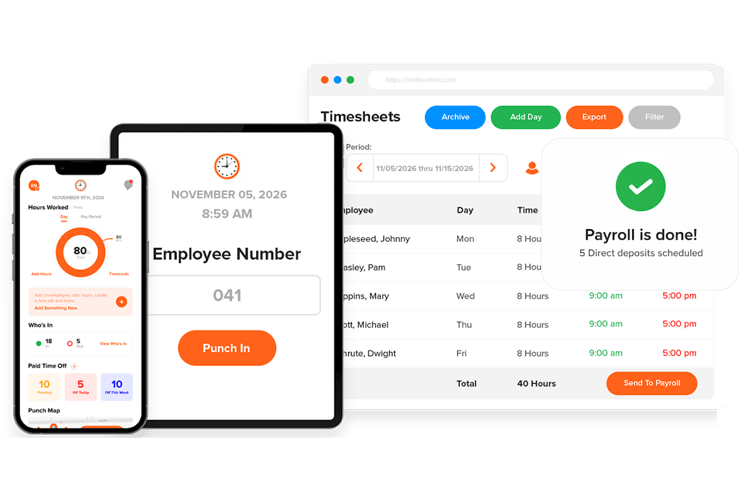
Why OnTheClock Is Best for Small and Mid-size Medical Practices
If you run a practice with five to 50 staff and you want clean payroll without a big bill, OnTheClock fits. It costs $5 a month as a base fee plus $4 per employee per month. For a 20-person office, that's $85 a month.
The value isn't the only reason it fits a medical office. Your team punches in using the method that works best for them: on a phone, shared kiosk tablet at the front desk, or computer. Fingerprint and PIN options stop buddy punching. GPS and IP restrictions ensure a punch can only happen from your clinic, not from a car in the parking lot. When payroll comes due, OnTheClock automatically enters the hours, and you can run payroll in minutes or export a clean report to your provider.
Why OnTheClock Is Different
We built our product in-house for small and mid-size businesses, and that focus shows in how fast a nontechnical office manager can set it up. You don't need an IT person. You add your team, set your clock-in rules, and go. It handles the messy parts of a medical schedule, too. Staff work across departments, cover for each other, and take PTO. You build schedules with drag-and-drop, assign people by role, and flag overtime risks before you finalize the week. The "Who's In" view shows who's working right now across every location, which helps when you're covering a busy front desk and three exam rooms at once.
Key Features
Pros
Cons
Pricing
- 30-day free trial, no credit card is required at sign-up
- $5/month base plus $4 per user/month (see how OnTheClock pricing works)

Homebase: Best for Single-Location Offices
Available on: Web, iOS, Android
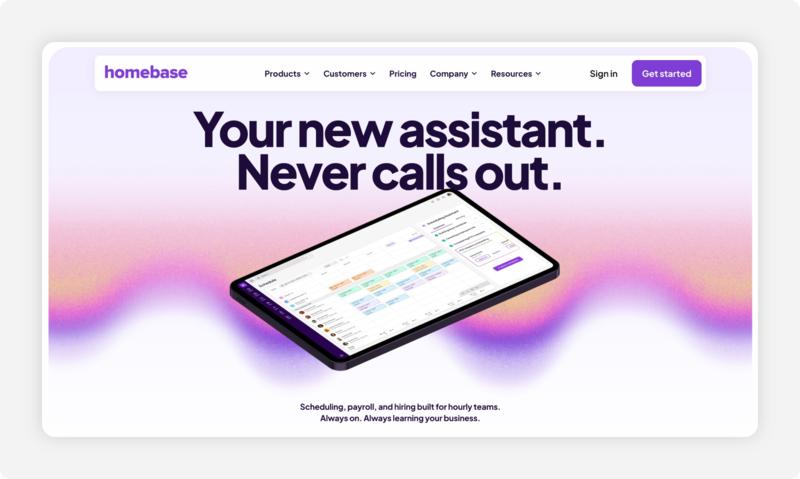
Why Homebase Is Best for Single-Location Offices
If you run one location with 20 or fewer staff and you want to spend nothing, Homebase is the pick. Its free plan includes a basic time clock and scheduling for a single site with no trial clock ticking down or expiration. For a solo dental office, chiropractic practice, or small family clinic, that covers the basics without a bill. Staff clock in from a shared tablet or their phones, and the hours are recorded in simple time sheets.
Here's the catch to watch. Homebase prices by location, so the free plan covers one site only. GPS and location-based clock-in verification are included in the paid Essentials tier, not the free plan. The moment you open a second office, the math changes, and you'll want to compare per-user tools like OnTheClock. For a single location that wants a free solution, Homebase is hard to beat.
Key Features
Pros
Cons
Pricing
- Free for one location, up to 20 employees
- Paid plans add GPS, multisite, and advanced tools

Clockify: Best for Simple, Low-Cost Tracking
Available on: Web, iOS, Android, desktop
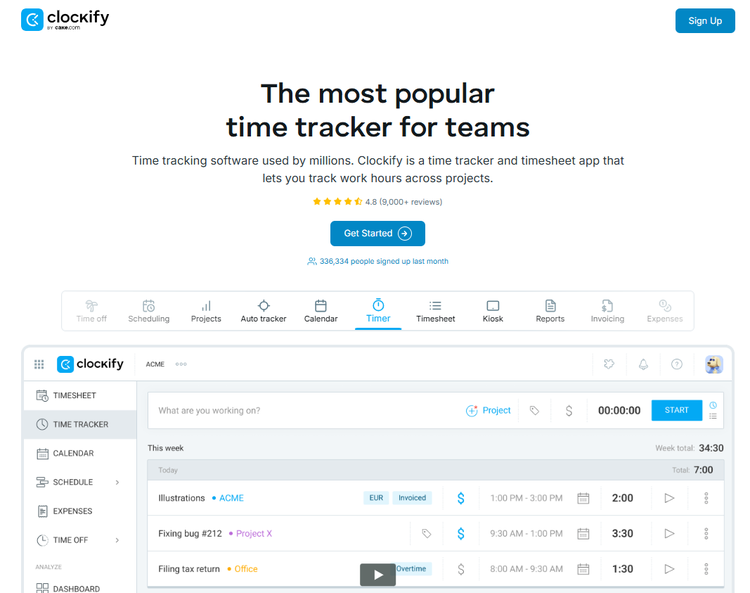
Why Clockify Is Best for Simple, Low-Cost Tracking
When you want the leanest possible clock for the lowest possible cost, Clockify delivers. Its free plan supports unlimited users, which almost no competitor matches. You can run a basic kiosk, track hours, and export time sheets without paying for headcount. The name says it all. Clockify is a straightforward time tracker first. Staff can clock in through the web or a mobile app, or you can set up a shared kiosk on a tablet at the front desk.
It fits a budget-conscious practice that mainly needs to log hours and doesn't need deep scheduling or compliance tooling. The trade-off is depth. Clockify leans toward project and productivity tracking, so the interface can feel busy for a manager who just wants quick timecard access. For simple, cheap hour logging, it's a smart choice.
Key Features
Pros
Cons
Pricing
- Free plan with unlimited users
- Paid tiers add kiosk extras and admin controls at low per-user rates

When I Work: Best for Nurse and Rotating-Shift Scheduling
Available on: Web, iOS, Android
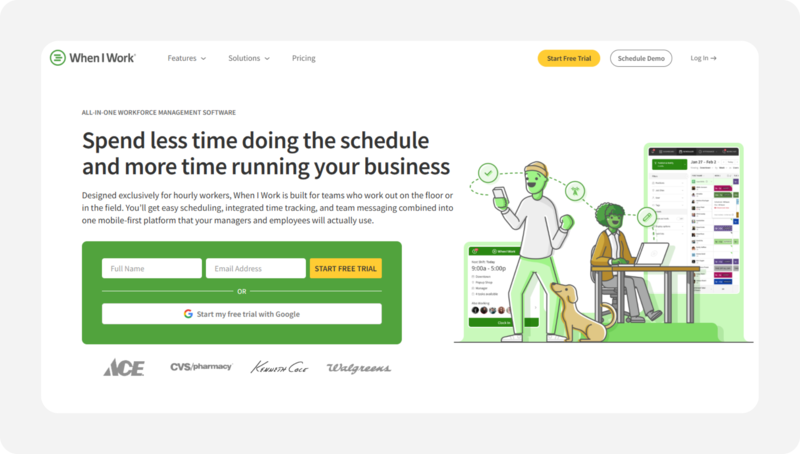
Why When I Work Is Best for Rotating-Shift Scheduling
If building the weekly nurse schedule is the part of the job that keeps you at the office late on Fridays, When I Work is built for you. It's a scheduling tool first, with a time clock built into the same view. Staff see their schedule in the app and clock in directly from it. Charge nurses can post open shifts, approve swaps, and spot coverage gaps across a rotating roster in one screen.
This fits nursing units, urgent care, and outpatient clinics where schedules change constantly. The compliance engine isn't as deep as some specialist tools, and time and attendance is a separate charge from the base scheduling plan, so check the full price for your team size. For schedule-first practices, the time saved each week is worth it.
Key Features
Pros
Cons
Pricing
- Paid plans start per user per month
- The time and attendance add-on is priced separately

ClockShark: Best for Home Health and Visiting Staff
Available on: Web, iOS, Android
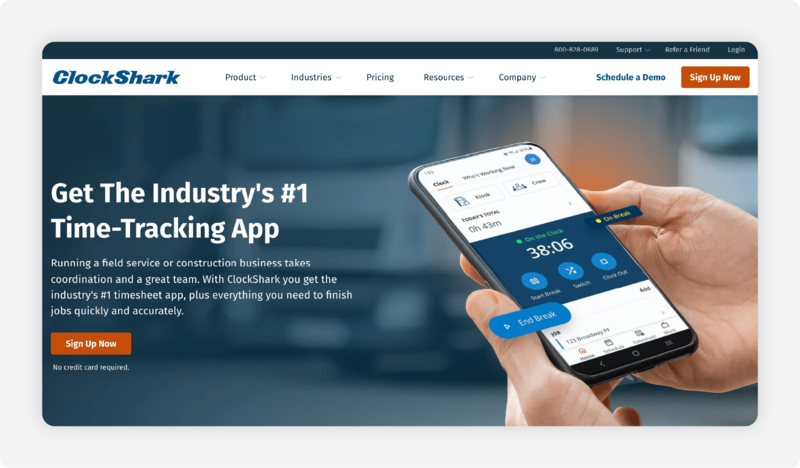
Why ClockShark Is Best for Home Health and Visiting Staff
If your staff drives to patients' homes, you need proof they were there, and you need the clock to work where the signal doesn't. ClockShark is the pick for home health agencies and visiting nurses because it pairs GPS and geofencing with true offline clock-ins. A home health aide pulls up to a rural address with one bar of signal, clocks in, and the punch records even without a live connection, then syncs when the phone reconnects.
Many fixed-office time clocks need a live connection to record a punch, so a dead signal at a patient's door means a missing record at exactly the moment you need proof of the visit. ClockShark is built to avoid that. The trade-off is that ClockShark started in field-service industries, like construction, so some features lean that way. For mobile medical staff, the offline GPS combination is exactly what they need.
Key Features
Pros
Cons
Pricing
- A free trial is available
- Paid plans start per user per month plus a base fee

Connecteam: Best for Practices that Need a HIPAA BAA
Available on: Web, iOS, Android
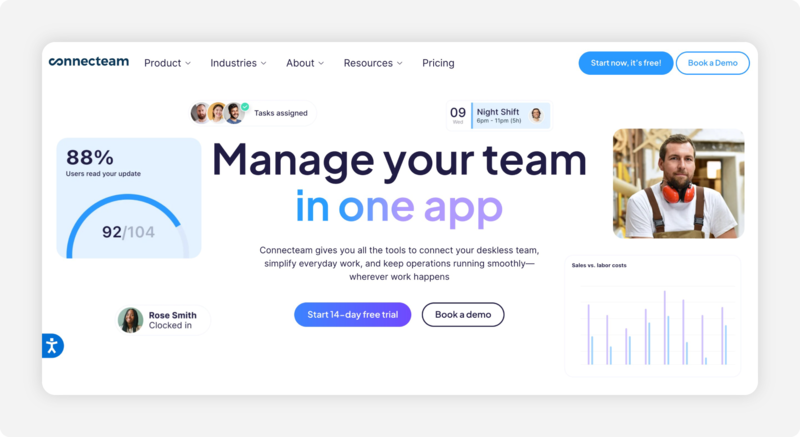
Why Connecteam Is Best for Practices that Need a HIPAA BAA
If your team logs any patient information in the time tool, or you simply want a signed HIPAA agreement on file, Connecteam is the cleanest option on this list. Its Trust Center spells out the terms plainly: HIPAA support applies to customers who enter into a business associate agreement, and the account must register and complete that BAA before HIPAA support is available. Additional charges apply for HIPAA-registered customers. Beyond the BAA, Connecteam is a full team management app with a time clock, scheduling, and staff communication, plus a free-for-life tier for very small teams.
This fits a practice that handles protected health information and won't move without a BAA. Two other tools publish HIPAA language worth knowing about. Hubstaff states it maintains HIPAA compliance and provides a BAA, though it notes the tool doesn't automatically enforce compliance and must be configured correctly. TimeCamp lists HIPAA among its security standards and runs a dedicated HIPAA page, though it's less explicit than Connecteam about a signed BAA. Read each vendor's own terms before you commit, because publishing a HIPAA security claim and signing a BAA aren't the same promise.
Key Features
Pros
Cons
Pricing
- Free for life for up to 10 users
- Paid plans per tier; HIPAA registration adds cost

Deputy: Best for Multisite Physician Groups
Available on: Web, iOS, Android
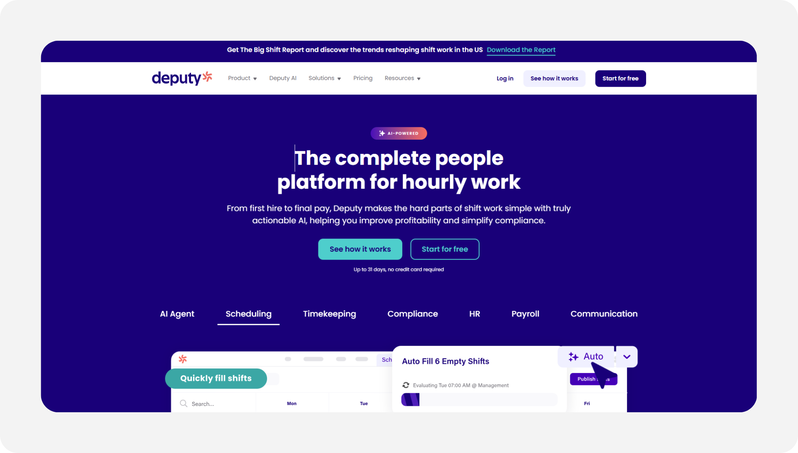
Why Deputy Is Best for Multisite Physician Groups
When you run several offices and need central oversight, Deputy scales. It combines deep scheduling, break and overtime rules, and multilocation management under one roof, which is what a growing physician group needs as it adds sites and staff. A regional manager sees all sites in one view, approves time sheets in bulk, and catches coverage gaps before they become call-outs.
This fits multisite groups and larger practices with real scheduling complexity. It's more tool than a solo office needs, and the per-user cost climbs as you grow, so it earns its place when scale is the actual problem. For a one-site clinic, the simpler picks above will serve you better and cost less.
Key Features
Pros
Cons
Pricing
- A free trial is available
- Paid plans per user per month, scheduling, and time tiers
.png?width=178&height=40&name=Gusto-logo%20(1).png)
Gusto: Best All-in-One Payroll Plus Time
Available on: Web, iOS, Android
.png?width=800&height=451&name=gusto-homepage-screenshot%20(1024%20x%20581%20px).png)
Why Gusto Is Best for All-in-One Payroll Plus Time
If you'd rather run payroll and time tracking in one place, Gusto is a good fit. It's a full payroll and HR platform with time tracking built into its Plus and Premium plans, so the hours your staff clock automatically flow into payroll without an export step. Because the tracked hours, taxes, and filings live in one system, Gusto markets payroll that runs in minutes rather than hours.
This fits a practice that wants payroll, benefits, and time under a single login and bill. The trade-off is that time tracking is a feature of a payroll platform, not a dedicated clock, so the punch tooling is lighter than specialist options. If payroll is your real headache and time tracking is secondary, Gusto solves the bigger problem first.
Key Features
Pros
Cons
Pricing
- Monthly base fee plus per-person fee
- Time tracking included on Plus and Premium plans
Side-by-Side Comparison
| Tool | Best For | Pricing | Key Strengths | Top Integrations |
|---|---|---|---|---|
| OnTheClock | Small and midsize practices | $5 base + $4/user/month | Value, anti-buddy punch, multilocation | QuickBooks, ADP, Gusto, Paychex |
| Homebase | Free single-location offices | Free for one location | Free clock and scheduling | QuickBooks, Gusto |
| Clockify | Simple, low-cost tracking | Free unlimited users | Cheapest at scale, flexible punch | QuickBooks, 80-plus apps |
| When I Work | Nurse and rotating-shift scheduling | Per user, time add-on | Strong shift scheduling | QuickBooks, Gusto, ADP |
| ClockShark | Home-health and visiting staff | Base + per user | Offline clock-in, GPS proof | QuickBooks, ADP, Gusto |
| Connecteam | Practices needing a HIPAA BAA | Free to 10; paid tiers | Documented BAA pathway | QuickBooks, Gusto, Paychex |
| Deputy | Multi-site physician groups | Per user per month | Compliance and scale | QuickBooks, ADP, Gusto, Xero |
| Gusto | All-in-one payroll plus time | Base + per person | Payroll in minutes | Built-in payroll, QuickBooks |
| QuickBooks Time | QuickBooks-based practices | Base + per user (increasing July 2026) | Tight QuickBooks payroll sync | QuickBooks, ADP, Gusto |
Comparison data verified June 2026 against each vendor's own site; subject to change by respective providers. QuickBooks Time raises Premium and Elite per-employee pricing by $2 effective July 1, 2026.
What's the Best Time Clock Software for Medical Practices?
The best option isn't the one with the longest feature list. It's the one that fixes the friction you actually hit. So, start with one question: What headache are you trying to resolve?
Your practice size, locations, and biggest daily pain point all point to a different pick. Match yourself to one of these:
- Want clean payroll, strong punch controls, and a small bill for a five-to-50-person practice? OnTheClock fits most offices here.
- Run one location on a tight budget and mostly need basic hours? Look at Homebase or Clockify.
- Will anyone log patient information inside the tool? You'll need a signed BAA, so look at Connecteam.
Your answer points to your pick. When the friction you encounter disappears, the rest of the week gets easier.
What Is Time Clock Software for Medical Practices?
Time clock software for medical practices is a digital tool that records when your staff clock in and out, then turns those punches into time sheets for payroll. Instead of a paper card or a manual log, employees punch in from a phone, shared tablet kiosk, or web browser, and the system automatically records the hours.
For a medical office, it tracks a mixed team: nurses, medical assistants, techs, and front-desk staff, often across shifts and sometimes across locations. Good software also tracks breaks, overtime, and PTO, so the record stays accurate and ready for payroll.
Who Needs Time Clock Software in a Medical Practice?
Any practice that pays staff by the hour needs it. That includes family practices, dental offices, urgent care clinics, specialty practices, and home health agencies. If your nurses, assistants, and front desk team are hourly, their hours decide their pay, so the record has to be right.
Practice managers and office administrators feel the pain most. They're the ones rebuilding time sheets on payroll day and answering for break and overtime records if a question ever comes up. A solo provider with one or two staff might get by on a spreadsheet, but the complexity climbs quickly with each new hire.
Why Medical Practices Rely on Time Clock Software
Medical practices run on tight schedules and thin margins, and payroll mistakes cost both money and trust. Staff work long shifts, swap coverage, and skip breaks during busy stretches. Tracking all of that by hand invites errors and disputes.
The software keeps the record honest and automatic. It captures every punch, flags overtime before it surprises you, and keeps a clean break record. That matters because labor law requires accurate pay for hours worked and breaks taken. You can read more in our guide to time tracking for health care. When the data is solid, payroll is fast, and you're protected if anyone ever questions the hours.
Key Features Time Clock Software Should Have
The right time clock for a medical practice covers the basics well before it adds extras. Before comparing prices, make sure any tool covers this checklist:
-
Multiple clock-in options: phone, kiosk tablet, and web, so every role can punch easily.
-
Buddy punch prevention: GPS, IP restrictions, PIN, or fingerprint to keep punches honest.
-
Break and overtime tracking: automatic records that meet FLSA rules and survive an audit.
-
Payroll integration: a clean feed to ADP, QuickBooks, Gusto, or built-in payroll.
-
Scheduling and PTO: shift assignment, swaps, and time-off tracking in one place.
-
Multilocation support: one account for one site or several, if you plan to grow.
How to Choose the Proper Time Clock Software for Medical Practices
Step 1: Name your biggest time-tracking headache. Before you look at any tool, write down the single problem that costs you the most time or money right now. Maybe it's payroll cleanup every Friday, or staff forgetting to clock in, or breaks that aren't recorded. The tool that solves your top headache is worth more than the one with the most features. Start there and judge every option against it.
Step 2: Count your locations and your staff. Your practice size shapes the pricing math more than anything else. A single office on a per-location free plan like Homebase costs nothing, but the moment you open a second site, a per-user tool like OnTheClock often costs less. List how many sites and employees you have today, and where you'll be in two years. Then compare the real monthly cost, not the sticker price.
Step 3: Check the break and overtime tools. Medical staff work overtime and skip breaks, and you have to pay both correctly. Under 29 CFR 785.18, short breaks of five to 20 minutes count as paid time, and bona fide meal periods of 30 minutes or more don't. Make sure the tool records breaks automatically, flags overtime before it happens, and keeps an audit trail you could hand to an auditor.
Step 4: Decide whether you need HIPAA coverage. Ask one question: Will any staff member ever type patient information into the time tool, regardless of whether that's in a note, chat, or shift comment? If so, you need a vendor that signs a business associate agreement, such as Connecteam. If the tool only ever holds staff punch data and no patient details, most mainstream clocks work fine. Don't pay for a BAA you don't need, and don't skip one you do.
Step 5: Test the punch experience, then confirm the payroll handoff. The best software fails if your team won't use it. During a free trial, have a nurse, tech, and front desk person each clock in and out for a few days, and watch where they get confused. Then run a sample export to your payroll provider or run payroll in the tool, and check that hours, overtime, and PTO carry over correctly. If both the punch and the handoff are clean, you've found your tool.
Tips for Implementing Time Clock Software Successfully
-
Roll it out with a short staff demo. Don't just email a login and hope. Spend 15 minutes showing your team how to punch in, request time off, and fix a missed punch. In a busy practice, a quick walkthrough prevents weeks of confused clock-ins. Adoption is everything; a tool nobody uses correctly is worse than the paper system you replaced.
-
Set your clock-in rules before day one. Decide your GPS or IP restrictions, rounding rules, and overtime alerts up front, then turn them on before staff start punching. Changing the rules mid-stream confuses people and muddies your records. Get the settings right first, and the data stays clean from the first pay period.
-
Review the first two pay periods, and keep a backup for outages. Watch the early data for late punches or missed breaks so you can coach staff before small problems become payroll headaches. Most of these tools require an internet or Wi-Fi connection, so decide what staff should do if the connection drops. For the federal rules behind break and overtime pay, see the U.S. Department of Labor.
Frequently Asked Questions
What's the best time clock software for a medical practice?
It depends on your biggest need. For a typical five- to 50-person practice that wants clean payroll, strong punch controls, and a small bill, OnTheClock is a strong fit. For free, single-location use, consider Homebase. For rotating nurse schedules, When I Work is a formidable option. For home health staff, ClockShark is adequate. For a signed HIPAA BAA, Connecteam may be the pick. Match the pick to the situation you're actually in.
Do medical practices need HIPAA-compliant time clock software?
Only if patient information is entered into the tool. A time clock that stores just staff punch data usually doesn't trigger HIPAA on its own. The risk appears when employees type patient names, appointment details, or health information into notes, chat, or shift comments. If that's possible in your practice, choose a vendor that has a business associate agreement, such as Connecteam. If not, most mainstream clocks are fine.
Do doctors and medical staff clock in and out?
Hourly staff do, and most practice teams are hourly: nurses, medical assistants, techs, and front-desk staff. Salaried providers often don't punch a clock, but practices still track their schedules and PTO. The software lets you track hourly and salaried staff differently in the same system.
How much does time clock software for a small medical office cost?
It ranges from free to a few dollars per employee per month. Homebase is free for one location with up to 20 staff. OnTheClock runs $5 a month base plus $4 per employee, so $85 a month for a 20-person office. Clockify offers a free plan for unlimited users. Full payroll platforms, like Gusto, cost more because they do more than track time.
What's the best free time clock for a single-location practice?
Homebase is the choice for most single-site offices. Its free plan covers a basic time clock and scheduling for one location with up to 20 employees, with no trial expiration. Clockify is another strong free option with unlimited users, if you need to cover more staff and don't mind a busier interface.
Can time clock software track breaks and overtime for compliance?
Yes, and a medical practice should insist on it. Good software records break time automatically and flags overtime before it happens. Federal rules under 29 CFR 785.18 treat short breaks of five to 20 minutes as paid time, so your clock needs to capture them to keep a clean, auditable record.
Start Tracking Time for Free
Payroll day shouldn't eat your Friday. Capture every punch, keep your break and overtime records clean, and send accurate hours straight to payroll, so you can get back to running your practice.
No credit card required, and you'll be set up in minutes.