Key Takeaways
- ✔The best time clock for a vision center is simple enough for front-desk staff to use without training, works on one shared terminal, and stops buddy punching.
- ✔OnTheClock is a formidable solution for vision centers because it is easy to set up, runs on a shared front-desk tablet, and shows hours across every location in one place.
- ✔Free options (Jibble, Homebase) fit a single, tight-budget office.
- ✔Look for three things first: an easy shared clock-in, real buddy punch prevention, and fair pricing with no per-location surprises.
- ✔Pick the tool that fixes the one thing you dread most; everything else is noise.
The best time clock software for vision centers is the tool that lets staff quickly clock in on a shared front-desk device, prevents buddy punching, and gives managers clean payroll hours across every location. For most small and multilocation vision centers, OnTheClock is the best overall option because it combines kiosk clock-in, photo verification, GPS controls, scheduling, PTO tracking, and transparent pricing in one place.
Now, picture why that matters. It is 8:55 a.m., and the waiting room is already filling up. Your first patient is early, the phone is ringing, and three staff members are crowded around the front desk trying to clock in on the same computer. One of them forgot to clock out last night, and now you're guessing what time they left.
Then, payroll day comes, and you're squinting at handwritten time records from two different offices, trying to make the numbers work.
If this sounds like your office, you're not alone. Selecting the optimal time clock software for your vision center fixes this. It lets your team efficiently clock in on one shared terminal, stops people from punching in for each other, and shows every location's hours on one screen. Under the Fair Labor Standards Act, short breaks of five to 20 minutes are paid, and overtime starts after 40 hours in a workweek. So, getting those hours right matters.
Below, we rank the nine best time tracking options for 2026 and explain why each may be a great fit for your office.
We graded each tool against the OnTheClock Vision Center Time Clock Scorecard, a weighted rubric built around what eyecare offices really need (more on that in a minute). Here is what we found.
What Most Vision Centers Actually Want from a Time Clock
Most owners do not lie awake wishing for more features; they just want their time clock to work.
We reviewed public customer feedback from sources such as G2, Capterra, app store reviews, and provider documentation. Through this process, the same three frustrations surfaced again and again.
First, the app freezes. Staff taps the button and nothing happens, or it logs the wrong location or quits the second the internet drops. At a busy front desk, that is a daily headache.
Second, the price keeps climbing. A small base fee becomes a per-person fee, then a charge for each additional location. Owners feel nickel-and-dimed.
Third, the verification is clumsy. It either fails, so you fix timecards by hand, or it feels like you are spying on your own team.
Underneath all three, the same thing surfaces: Vision centers are not chasing software; they're chasing a calm morning and clean payroll.
Quick Picks: Which Time Clock Best Fits Your Vision Center
-
OnTheClock: Best overall for vision centers
-
Deputy: Best for face-scan clock-in
-
Jibble: Best free option
-
Buddy Punch: Best for stopping buddy punching
-
uAttend: Best physical front-desk clock
-
When I Work: Best for shift scheduling
-
Homebase: Best for one location
-
QuickBooks Time: Best for QuickBooks users
-
Connecteam: Best for team messaging
How We Evaluated These Time Clocks
A "best" list only means something if you know what we've measured. We built the OnTheClock Vision Center Time Clock Scorecard before we looked at a single product. The criteria came from what vision centers actually deal with, not from what any one tool happens to do well.
Here is what we graded on:
-
Ease of use: Can a front-desk worker or optician clock in with no training?
-
Shared kiosk clock-in: Can several staff members punch in on one front-desk device?
-
Buddy-punch prevention: Does a PIN, photo, or location check confirm the right person?
-
Multi-location visibility: Can you see every office's hours on a single dashboard?
-
Break and overtime tracking: Does it handle paid breaks and overtime for hourly staff?
-
Pricing transparency: Do you know the bill before you sign, with no per-location surprise?
-
Payroll export: Do the hours flow to your payroll provider cleanly?
Ease of use and shared clock-in carried the most weight. Those are the two things a front desk feels every single day. We also leaned toward tools that handle time tracking and scheduling on their own, not thin add-ons bolted onto a payroll service.
The Best Time Clock Software for Vision Centers in 2026
Below, we break down nine tools that actually serve the vision center audience. For each one, we cover who it fits, what it does well, and where it may fall short.

OnTheClock: Best Overall for Vision Centers
Available on: Web, iOS, Android
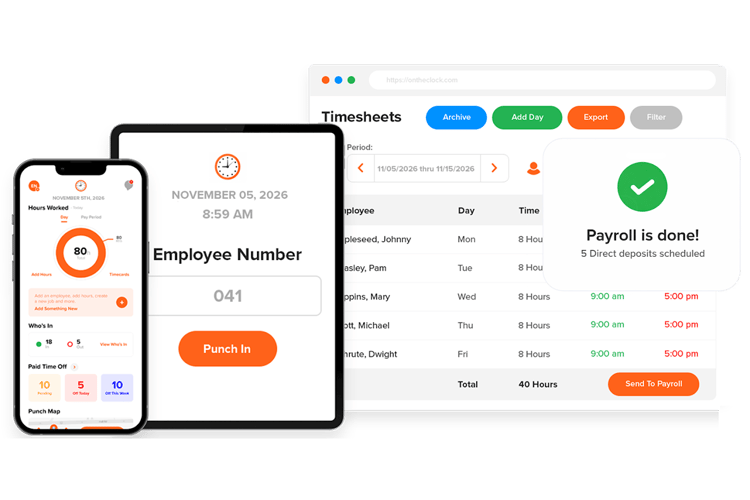
OnTheClock is the best fit for most vision centers because it's simple, runs on the shared front-desk tablet, and shows every office in one view. Staff clock in within seconds, and you can set it up the same day with no training or IT help.
What Makes it Different for Vision Centers?
That simplicity is the whole point. An optician should not need a manual to punch in. They tap one button, and a photo and location stamp confirm it was really them, not a coworker covering for a late start. What sets it apart for eyecare is the multilocation view. Run a main office and a satellite clinic, or several optical shops, and you can see each location's hours in a single dashboard.
This fits independent practices and small optical chains with five to 75 hourly staff with a front desk sharing one terminal and at least some coverage beyond 9 to 5. Owners do not want to pay for software and then commit a bunch of time into training their team how to use it.
Picture a four-office optometry group that outgrew handwritten time sheets. Before, payday meant rebuilding the numbers by hand from four sets of paper records. With OnTheClock, every office's hours are already totaled on one screen. Scheduling, paid time off, and overtime tracking live in the same place, so the front desk and the optical floor stay organized together.
Key Features
Integrations:
Pros
Cons
Pricing
- A free, 30-day trial is available (no credit card)
- $5 monthly base fee plus $4 per user per month
Built to Simplify Your Front Desk
Try it free, and see how effortless time tracking can be.
Try Free
Deputy: Best for Face-Scan Clock-In
Available on: Web, iOS, Android
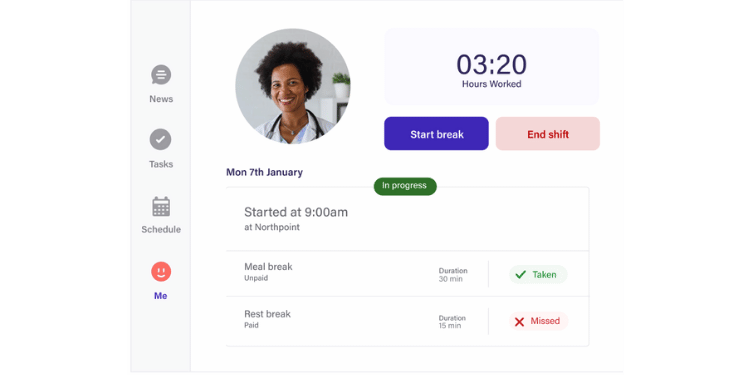
Worried about who is actually punching in? Deputy answers that. Its tablet kiosk reads faces to confirm each person at clock-in. You set an iPad at the front desk, the staff looks into the camera, and the correct name goes on the clock.
It is also strong at scheduling. If your exam lanes and optical floor need shifts mapped out, Deputy handles it well with built-in demand-based scheduling and overtime alerts.
The trade-off is focus. Deputy leans toward scheduling first, so the time clock feels like the second job rather than the main one. A small office that only wants a clock may find more here than it needs.
Key Features
Integrations:
Pros
Cons
Pricing
- From $5 per user per month; 31-day free trial

Jibble: Best Free Option
Available on: Web, iOS, Android
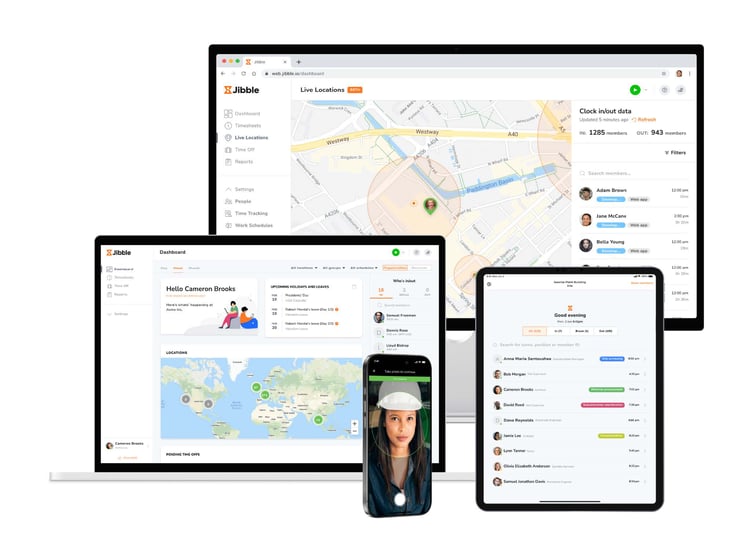
Budget tight? This is your pick. Jibble's core time clock is free for unlimited users, including the kiosk and face recognition that most tools charge for. A small practice can run a real-time clock without paying a cent.
It works on a tablet, a phone, or the web, so a front desk and a remote staff member can both use it. It even handles offline clock-in, which is rare at this price.
The catch is depth. The deeper reports and advanced features are available only with paid plans, and the scheduling tools are lighter than those of rivals. For a single office that mostly needs honest punches, that is a fair trade.
Key Features
Integrations:
Pros
Cons
Pricing
- Free for unlimited users; paid plans from about $4 per user per month

Buddy Punch: Best for Stopping Buddy Punching
Available on: Web, iOS, Android
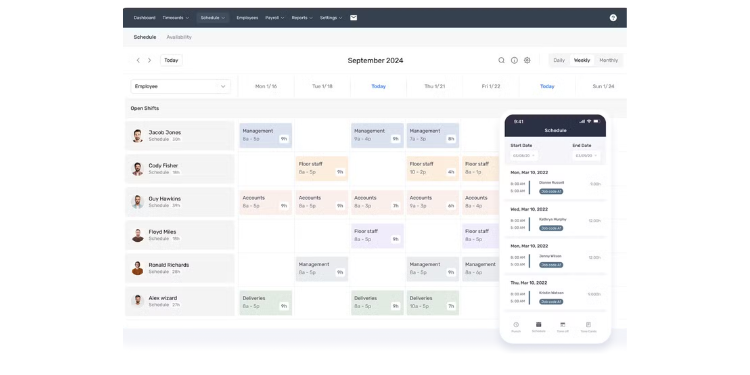
The name says it all. Buddy Punch is built around one job: making sure nobody clocks in for a coworker. It does that better than anyone with a PIN, photo, webcam shot, QR code, and face recognition.
You choose the method that fits your front desk. For an office where coverage is thin and trust matters, that layered check brings real peace of mind.
It does need a steady internet connection, and there is no offline mode. The monthly base fee, in addition to the per-user rate, can also sting a very small team.
Key Features
Integrations:
Pros
Cons
Pricing
- $19 monthly base fee plus from $4.49 per user per month; 14-day trial

uAttend: Best Physical Front-Desk Clock
Available on: Web, iOS, Android, physical clocks
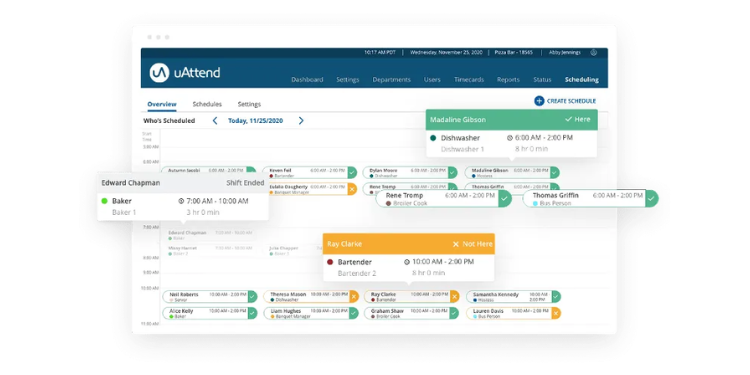
Some offices want a real device on the counter, not just an app. uAttend delivers that. Staff use a fingerprint, card, or PIN on a small wall or counter clock, and it syncs to the cloud.
If you want a single fixed spot where everyone punches in, this is the cleanest solution. It pairs the hardware with web and app options, so you are not locked into one method.
Because it is built around the hardware, it suits a fixed desk better than a roaming team, and setup takes a little more effort than an app-only tool.
Key Features
Integrations:
Pros
Cons
Pricing
- Tiered by team size, plus a one-time cost for the physical clock

When I Work: Best for Shift Scheduling
Available on: Web, iOS, Android
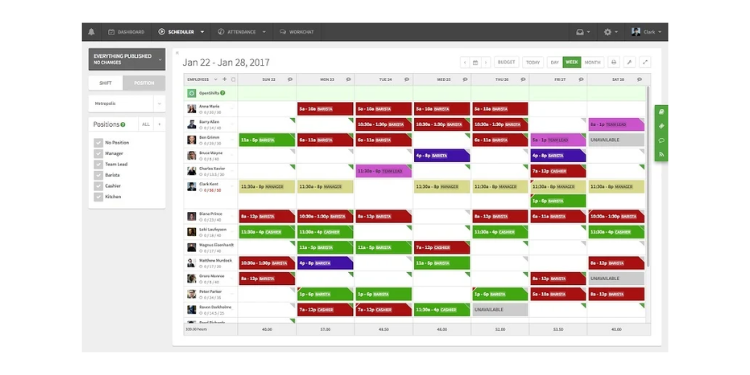
If scheduling is what breaks your week, look here. When I Work lets you build shifts quickly, sends them to staff phones, and lets people swap shifts with approval. The time clock rides along with a photo clock-in.
For a vision center, juggling part-time opticians and rotating front desk coverage, the scheduling side does the heavy lifting. Open shifts get filled from the same app where you publish the schedule.
One watch-out from reviews: Some teams report the clock-in freezing when many people punch in at once. The time clock can also require an add-on to the scheduling plan.
Key Features
Integrations:
Pros
Cons
Pricing
- Scheduling from $2.50 per user per month; time clock add-on extra

Homebase: Best for One Location
Available on: Web, iOS, Android
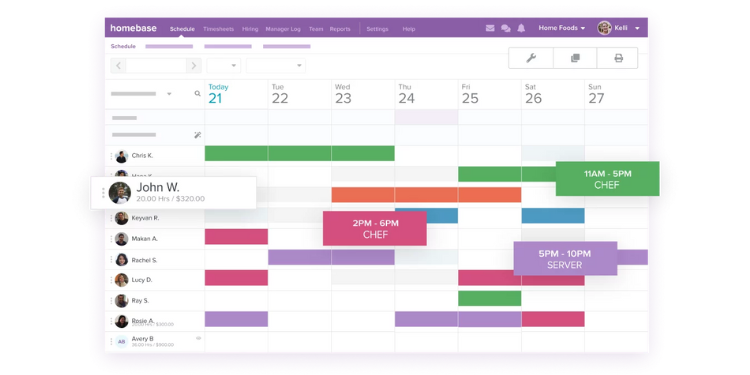
Running a single office on a tight budget? Homebase is the value play. Its free plan covers one location and a small team, and you still get a tablet kiosk with PIN and photo punch, scheduling, and basic reports.
For one independent practice, that free plan does almost everything you need on day one. It even adds hiring and messaging tools most clocks skip.
The limit shows up when you grow. Homebase charges per location, so a multi-office optical group pays full price for each site. Some users also report occasional app glitches.
Key Features
Integrations:
Pros
Cons
Pricing
- Free for one location; paid plans from $24.95 per location per month

QuickBooks Time: Best for QuickBooks Users
Available on: Web, iOS, Android
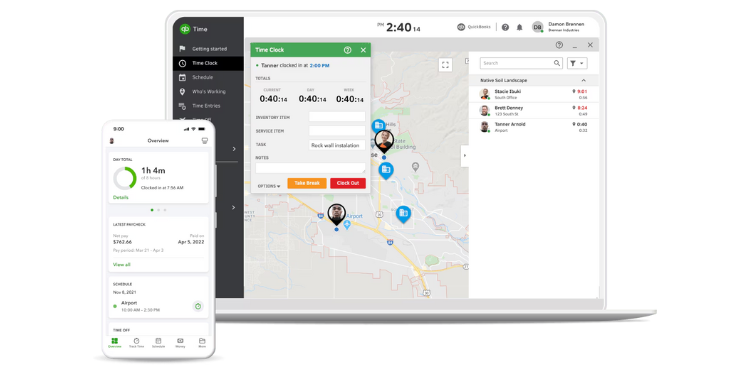
Already living in QuickBooks? This choice is easy. QuickBooks Time automatically enters your hours into the books you already keep. The hours your team clocks flow right into your existing payroll, with no exporting or cleanup.
It also offers a kiosk and GPS tracking, so it works as a real-time clock, not just an add-on. For an office already paying for QuickBooks, the tie-in is hard to beat.
The cost of that tie-in is the tie-in itself. You need QuickBooks Online to use it, and it runs more expensive than most tools on this list.
Key Features
Integrations:
Pros
Cons
Pricing
- From $20 monthly base plus $8 per user per month; 30-day trial

Connecteam: Best for Team Messaging
Available on: Web, iOS, Android
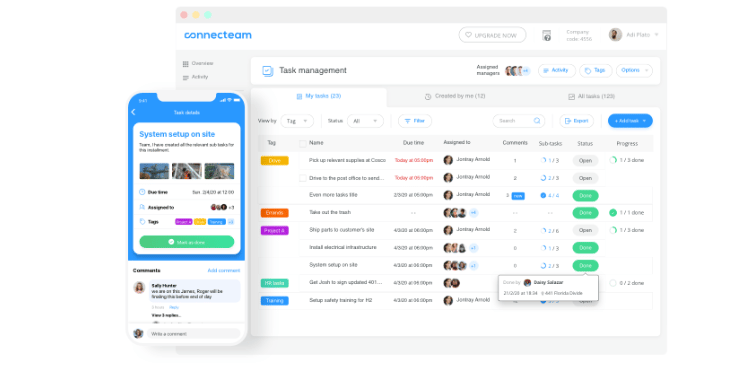
Want clock-ins and team chat in one app? Connecteam combines them. It pairs the time clock and kiosk with built-in chat, checklists, and updates, so you reach the whole staff in one place.
It is also free for up to 10 users. For a small team that wants one app for punching in and staying in touch, this covers both.
The pricing is the puzzle. Connecteam groups are organized into "hubs," which can be confusing to navigate, and, like most tools here, it needs an internet connection to work.
Key Features
Integrations:
Pros
Cons
Pricing
- Free for up to 10 users; paid plans from $29 per month
Side-by-Side Comparison Table
Why Choose OnTheClock?
See how OnTheClock stacks up against other time clock software for vision centers.
| Tool | Best For | Pricing | Key Strengths | Top Integrations |
|---|---|---|---|---|
| OnTheClock | Vision centers overall | $5 base + $4/user | Shared kiosk and multi-location view | ADP, QuickBooks, Gusto, Square |
| Deputy | Face-scan clock-in | From $5/user | Kiosk facial recognition | Gusto, ADP, QuickBooks, Xero |
| Jibble | Free option | Free; paid from ~$4/user | Free kiosk and face scan | QuickBooks, Gusto, Xero |
| Buddy Punch | Stopping buddy punching | $19 base + from $4.49/user | Six verification methods | QuickBooks, Gusto, ADP, Paychex |
| uAttend | Physical desk clock | Tiered by team size | Biometric hardware clocks | QuickBooks, ADP, Paychex |
| When I Work | Shift scheduling | From $2.50/user | Scheduling with photo punch | Gusto, QuickBooks, ADP, Square |
| Homebase | One location | Free; paid from $24.95/location | Strong free plan | QuickBooks, Gusto, ADP, Square |
| QuickBooks Time | QuickBooks users | $20 base + $8/user | Deep QuickBooks tie-in | QuickBooks, Gusto |
| Connecteam | Team messaging | Free up to 10; from $29/month | Time clock plus chat | QuickBooks, Gusto, Paychex |
Comparison data based on 2026 market research and subject to change by respective providers.
What's the Best Option for Your Vision Center?
The best tool is not the one with the longest feature list; it's the one that fixes the friction you feel every day. Start with one question: What part of your week do you dread?
If you dread fixing timecards every payday, your answer is whatever has the strongest verification, like OnTheClock or Buddy Punch.
If you dread the morning crowd at a shared computer, your answer is to use a real kiosk like OnTheClock, Deputy, or uAttend.
If you dread merging hours from multiple offices, your answer is whatever shows all locations on a single dashboard, which is where OnTheClock shines.
If you dread the bill, your answer is whatever starts free, like Jibble or Homebase.
When the friction you actually feel disappears, the time clock stops being a daily headache. It becomes a calm front desk and a clean payroll, week after week.
What Is Time Clock Software for Vision Centers?
Time clock software for vision centers is a tool that records when your employees start and stop work. It replaces paper time sheets, punch cards, and spreadsheets. Staff clock in and out on a phone, tablet, computer, or small wall device. The software adds up their hours, tracks breaks and overtime, and gets the totals ready for payroll. For an eyecare office, it turns a messy front-desk task into a few quick taps.
Which Vision Centers Need Time Clock Software?
-
Independent optometry practices tracking front desk and tech hours
-
Multilocation optical chains that need every store's hours in one place
-
Ophthalmology clinics with technicians and assistants on shifts
-
Optical retail shops with part-time sales staff
-
Mixed clinic-and-retail offices juggling exam lanes and a sales floor
The common thread: Anyone who pays staff by the hour and does not want timekeeping to eat their week.
How Time Clock Software Works for Vision Centers
Time clock software records each punch, verifies the employee, calculates hours, and prepares approved payroll totals. Each employee gets a way to clock in, and the software handles everything after that.
When staff members arrive, they punch in. At a vision center, that usually happens on the shared tablet at the front desk, though it can also be a phone, a computer, or a small wall device. The moment they tap the button, the software records the exact time, down to the minute. Most tools also capture a photo or a location stamp right then, so you have proof the right person clocked in and not a coworker covering for them. When that person leaves for lunch, the optical floor, or home, they punch out the same way.
Behind the scenes, the software does the math you used to do by hand. It adds up the day's hours, separates regular time from overtime once someone has worked 40 hours in a week, and tracks paid breaks as the law requires. If a staff member forgets to clock out, the system flags it, so you don't have to guess.
For a vision center, the payoff lands on payday. Every hour from every location is already totaled and waiting on one screen. You scan it, fix anything that looks off, approve it, and send it to your payroll provider. The task that used to swallow a Friday afternoon takes a few minutes.
Why Vision Centers Rely on Time Clock Software
Once an office switches, most never go back. The reasons stack up fast.
Accuracy comes first: Real punches replace guesswork, so paychecks are right. Compliance follows: breaks and overtime are tracked as the law requires. Then there is cost control, because you stop paying for time nobody worked, and transparency, because staff and managers see the same record, so disputes drop. The biggest win is time. Payroll that took hours now takes minutes. For a small office, the time saved is the difference between leaving on time and staying late on Friday.
Key Features a Vision Center Time Clock Should Have
Not every time clock is built for an eyecare office. A construction app is built for muddy job sites, while a freelancer's timer is built for billing a single person's hours. Neither one understands a front desk, where three people share a screen, and patients are waiting. Look for these:
-
Shared kiosk mode: Several staff members need to punch in on one front desk device, so this is the feature most generic tools get wrong.
-
Buddy punch prevention: A photo, PIN, or location check confirms the right person is clocking in, protecting your payroll and your honest staff.
-
Multilocation reporting: One dashboard for every office, so you are not logging in three times to see three sets of hours.
-
Automatic overtime and break tracking: The software should do the labor-law math for your hourly opticians, techs, and front-desk staff.
-
Easy payroll export: Hours should flow straight to ADP, QuickBooks, Gusto, or Square with no cleanup.
-
A mobile app: Useful for an owner checking hours between offices or a staff member working off-site.
-
Simple setup: If it takes training just to clock in, your team will resist it.
If a tool nails the first three, it will serve a vision center well. The rest are helpful extras, not deal-breakers.
How to Choose the Right Time Clock for Your Vision Center
Step 1: Set your goal
Before you compare a single tool, name what you most need to fix. Maybe the staff is clocking in for each other. Maybe payroll takes too long because you are merging times from two offices. Maybe you just outgrew paper. Write the main problem in one sentence, because it will guide every choice after this.
Step 2: Map your team
Count your hourly staff and notice how they actually work. A single-office practice with four front desk people is a very different setup from a three-location optical chain with a manager who drives between sites. Write down how many people clock in, where they clock in, and whether anyone works off-site.
Step 3: Separate must-haves from nice-to-haves
Be honest about what you truly need. For most vision centers, a shared kiosk and buddy punch prevention are must-haves. Detailed analytics or team chat might be nice, but you can live without them. This list keeps a flashy feature from pulling you toward the wrong tool.
Step 4: Build a short list
Pick three or four tools from this guide that match your office, not 10. Comparing too many leads to paralysis. Lean on the "best for" labels above to narrow fast.
Step 5: Test the clock-in yourself
Sign up for the free trials and pretend you are a new optician on your first morning. Tap through clocking in and out. If it feels slow or confusing to you, it will frustrate your staff every single day.
Step 6: Check accuracy and compliance
Make sure overtime kicks in after 40 hours in a week and that paid breaks are tracked correctly. A clock that gets the labor law math wrong creates bigger problems than the one it solved.
Step 7: Confirm payroll fits
Check that the tool connects to the payroll provider you already use. The whole point is to move hours into payroll without extra work, so this step is not optional.
Step 8: Run a small pilot.
Before you commit, try the tool at one location or with two or three staff for a week. A short pilot exposes any setup issues while they are still small and easy to fix.
Step 9: Add up the true cost
Look past the headline price. Add the base fee, the per-employee charge, and any per-location fee together to get your real monthly number. A tool that looks cheap can get expensive once you count every office.
Step 10: Choose and roll it out
Make the decision, set it up, and tell your team what is coming and why. A clear heads-up turns a surprise into a smooth start.
Tips for Rolling it Out at Your Vision Center
-
Explain the why. Tell staff this is about correct paychecks, not spying on them, and the resistance usually fades.
-
Keep training short. If the tool is simple, a one-minute walkthrough at the front desk is enough.
-
Start with a pilot. Test the clock at your main office, or with two or three people, before you roll it out everywhere.
-
Check the reports early. Look at the first week of hours to catch any incorrect overtime rules or missing locations.
-
Handle pushback fast. A worry answered on day one stays small instead of spreading to the whole team.
Conclusion: Why the Proper Time Clock Pays Off for Vision Centers
The right time clock gives everyone something back. Employees get paychecks they can trust, with no fights over missed minutes. Managers get their Friday afternoons back, instead of fixing time sheets by hand, and owners get a clear, honest record of every hour across every location.
The tool you pick does not have to be perfect; it has to fix the one thing you dread most. When that is gone, the front desk gets calmer, and payroll gets cleaner, week after week.
Frequently Asked Questions
What is the best time clock software for a small optometry office?
For most small offices, OnTheClock is the best fit. It's simple, works on a shared front desk tablet, and shows every location in one place. Jibble and Homebase are strong free options if budget is your top concern.
How do I stop buddy punching at the front desk?
Use a tool with photo, PIN, or face verification. OnTheClock, Buddy Punch, and Deputy all confirm who is actually clocking in, so no employee can punch in for another.
Can I track hours across multiple optical locations?
Yes. Tools like OnTheClock display each location's hours on a single dashboard. This is a must-have for chains and practices with satellite offices.
Do these tools run payroll?
Most do not run payroll themselves. They are time clocks that send your hours to a payroll provider like ADP, QuickBooks, Gusto, or Square. That keeps the clock simple and lets you keep the payroll you already use.
Are employee breaks paid?
Under federal law, short breaks of five to 20 minutes are paid and count as work time. Longer meal breaks of 30 minutes or more are usually unpaid. Good time clock software tracks this for you (U.S. Department of Labor).
How long does it take to switch time clock systems?
Most small offices switch in a few days. Simple tools like OnTheClock can be set up the same day, since there is no hardware to install.
How much does time clock software cost for a small practice?
It varies. Some tools are free for small teams, while others charge a base fee plus a few dollars per employee each month. See the comparison table above for current pricing.
Ready to Simplify Your Front Desk?
Try OnTheClock free for 30 days. No credit card, contract, or setup fees. Get your time clock, scheduling, and reports in one place, and set up your front desk in about five minutes.
Start Tracking Time for Free