

Jump to section
Try OnTheClock Free
Save time and make payroll effortless with our easy-to-use, affordable employee time tracking app.
Try It FreeKey Takeaways
- ✔OnTheClock is the best pick for small real estate teams. One plan at $5 a month plus $4 per user covers GPS property proof, scheduling, PTO, and mileage.
- ✔Your people work across scattered properties. GPS and geofencing confirm which listing or unit a punch came from, so a client question never stumps you.
- ✔Drive time and mileage leak money. At the 2026 IRS rate of 72.5 cents a mile, untracked trips between properties add up fast.
- ✔A shared front desk invites buddy punching. A photo or facial check at clock-in stops one person from punching in for another.
- ✔Run two real quotes before you buy. The per-user rate and any base fee decide your true monthly cost, not the headline price.
A leasing assistant who runs between three open houses can drive 500 miles in a month, and at the 2026 IRS business rate of 72.5 cents a mile, that unlogged drive time quietly drains a real estate budget. The best real estate time tracking software earns its keep the moment scattered property visits turn into one clean, provable paycheck. It proves where your people worked, counts the miles between stops, and moves those hours into payroll without a Friday rebuild.
Most clocks assume one office, one schedule, one manager who can see everyone. Your team doesn't work that way. Agents, leasing staff, and maintenance techs spread across listings, units, and job sites, and the hours have to follow them. Reviewers on G2 and Capterra keep raising the same three pains: hours they can't prove across scattered properties, drive time and mileage logged by guesswork, and missed punches at a shared front desk that wreck payroll.
No single tool wins for every office. Below are seven picks, each matched to a real situation, starting with the one for small real estate teams.
What Real Estate Teams Actually Want From Time Tracking
Real estate teams want proof first. Work happens away from the desk, at showings, units, and closings, so the punch has to carry a location, not just a timestamp. That single need shapes almost every other choice on this list.
They also want the miles to count. People drive all day between properties, and those trips feed both payroll and reimbursement. Automatic mileage plus a clean export to payroll keeps drive time from turning into a monthly guess.
And they want one honest view of a mixed crew. Salaried agents, hourly admins, and part-time leasing staff all clock differently, so the right pick shifts with whichever gap you feel most.
Quick Picks: The Best Time Tracking Software for Real Estate at a Glance
-
OnTheClock: Best for small real estate teams
-
Timeero: Best for mileage tracking
-
Connecteam: Best for property maintenance crews
-
Homebase: Best free option for a single office
-
When I Work: Best for scheduling leasing staff
-
Buddy Punch: Best for stopping buddy punching
-
Hubstaff: Best for mobile agents
How We Evaluated the Best Time Tracking Software for Real Estate
We judged each tool on what actually matters across properties, not on feature-sheet length. We compared every option against the eight needs real estate teams keep raising, what we call the OnTheClock Real Estate Time Tracking Checklist:
-
Location proof: GPS and geofencing that confirm which property a punch came from.
-
Mileage capture: automatic drive-time and mileage logging between stops.
-
Punch verification: a photo, PIN, or facial check that stops buddy punching at the front desk.
-
Flexible punch methods: a mobile app for field staff and a kiosk for the office.
-
Scheduling: drag-and-drop shifts for leasing and front desk coverage.
-
Overtime and PTO rules: alerts that catch the 40-hour line and track time off.
-
Payroll and accounting fit: clean exports to the tools you already run.
-
Honest pricing: a true monthly cost with no surprise base fees.
OnTheClock earns the small-team spot here because it covers all eight needs in one base plan: GPS and geofencing, scheduling, PTO, mileage, and overtime alerts, with none of the real estate features held back for a higher tier. That breadth at the base price is the basis for the small-team label, not a ranking against the other picks. Each of the others serves its own situation best.
The Best Time Tracking Software for Real Estate
Below, the best time tracking software for real estate, with the right pick for each situation. For each one, we cover who it fits best, where it stands out, and where it may not be the right move.

OnTheClock: Best for Small Real Estate Teams
Available on: Web, iOS, Android
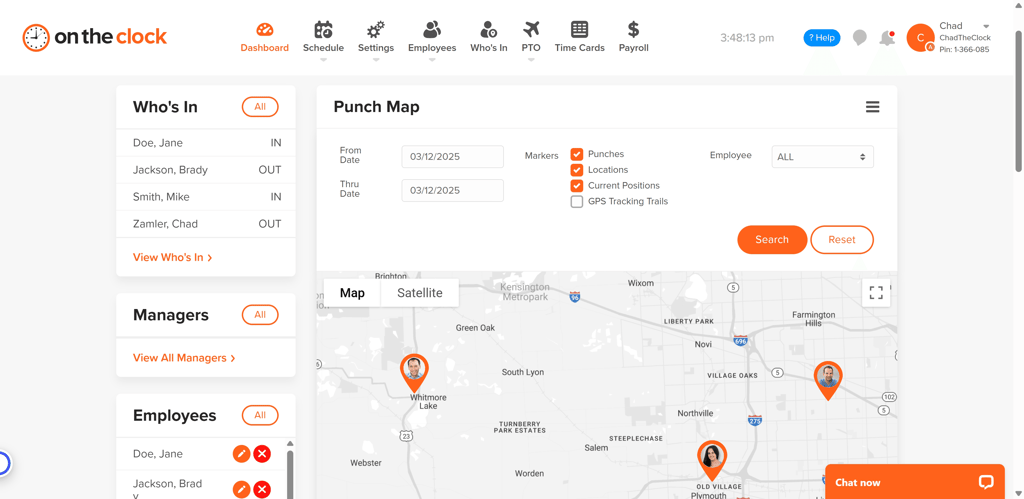
Why OnTheClock Is Best for Small Real Estate Teams
OnTheClock fits the small brokerage or property management office that runs a mixed hourly crew across listings and units. It proves who worked where, schedules the week, and exports clean hours, all from one plan. The buyer here is the owner or office manager who wears the payroll hat too.
It meets every need on the checklist in the base plan. GPS and geofencing tie a punch to the property, the live dashboard shows who's clocked in across the portfolio, and missed-punch alerts surface a problem before it reaches a client. Century 21 is among the 16,000-plus companies that run on it, so the fit isn't theoretical. You can see how OnTheClock works for real estate teams in more detail.
Why OnTheClock Is Different
One plan, no fine print. It's $5 base a month plus $4 per user, and the real estate features come included, not gated behind a pricier tier. A six-person office pays $29 a month, and seasonal swings don't sting because billing only counts active users.
Owners who got burned by a heavier platform tend to land here for the simplicity. The honest trade-off: punches need an internet or Wi-Fi connection, and the reporting is lighter than an enterprise suite built for deep portfolio analytics.
Key Features
Pros
Cons
Pricing
- 30-day free trial, no credit card
- $5 base a month plus $4 per user a month (see how OnTheClock pricing works)
- Optional payroll add-on: $40 base a month plus $6 per employee a month

Timeero: Best for Mileage Tracking
Available on: Web, iOS, Android
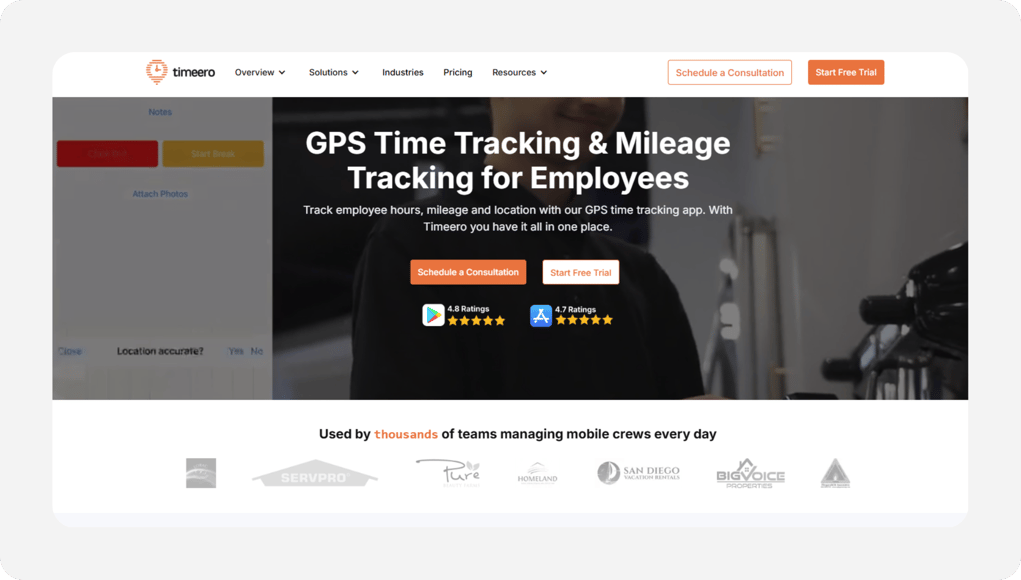
Why Timeero Is Best for Mileage Tracking
Timeero fits the agent or property manager who lives in the car. It logs the drive automatically, so the miles between a listing, a closing, and a maintenance call land on their own without anyone writing them down. The buyer is the office that reimburses mileage and wants the math to be airtight.
Its standout is the GPS breadcrumb trail and segmented tracking, which show a whole workday from one clock-in: each stop, each drive, each mile. That's a strong fit for IRS-rate reimbursement. The caution: scheduling and geofencing only open up on the Pro plan, so a smaller need can still push you up a tier.
Key Features
Pros
Cons
Pricing
- 14-day free trial, no credit card
- Basic $6 per user a month (up to 10 users), Pro $9 per user a month, Premium $12 per user a month

Connecteam: Best for Property Maintenance Crews
Available on: Web, iOS, Android
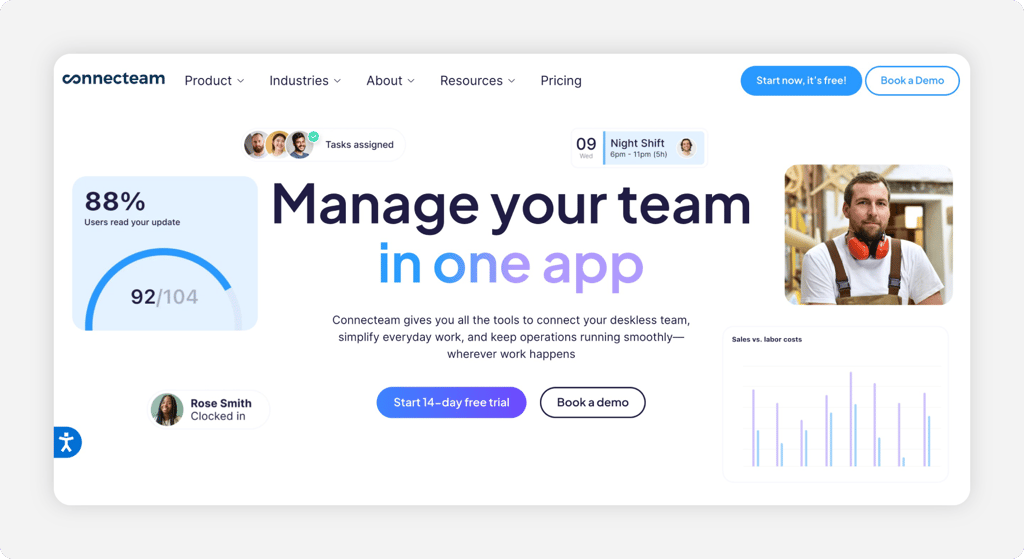
Why Connecteam Is Best for Property Maintenance Crews
Connecteam fits the property management company with a deskless maintenance crew. Techs clock in at the unit, pull up the work order, check off the punch list, and message the office, all from one phone app. The buyer is the operations lead juggling turnovers across many doors.
Where it stands out is breadth for field teams: the GPS time clock sits next to forms, task management, and chat, so a crew doesn't bounce between apps. The caution shows up in price. The free plan is generous for up to 10 users, but the paid Operations tiers jump quickly once a crew grows past that, and the all-in-one app can feel heavy for an office that just wants a clock.
Key Features
Pros
Cons
Pricing
- Free Small Business plan for up to 10 users
- Paid Operations plans for up to 30 users: Basic $29 a month, Advanced $49 a month, Expert $99 a month (billed annually), then a small per-user fee beyond 30

Homebase: Best Free Option for a Single Office
Available on: Web, iOS, Android
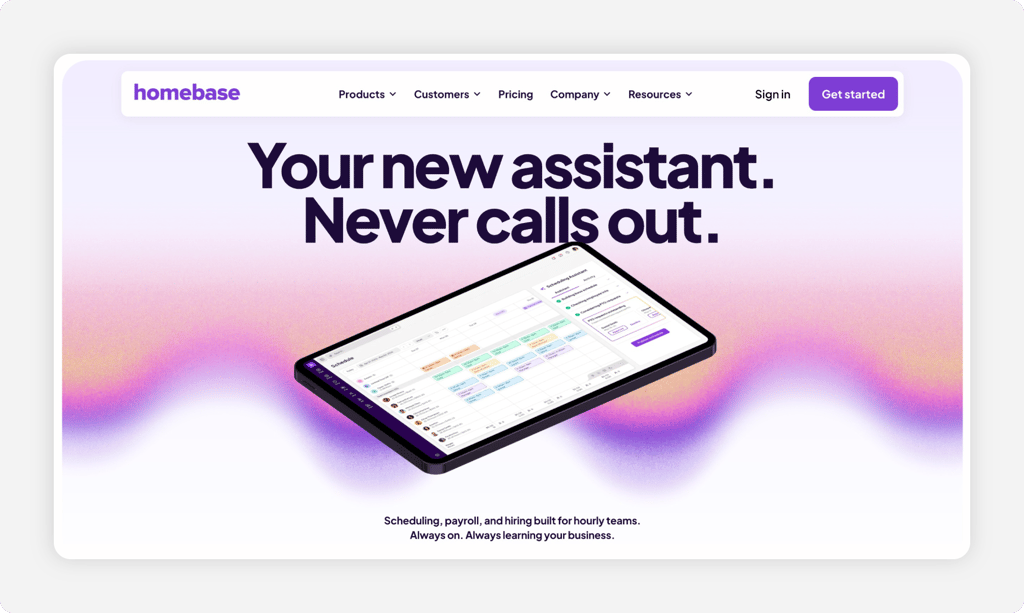
Why Homebase Is Best Free for a Single Office
Homebase fits the single real estate office that wants a real clock without a bill. The free Basic plan covers one location with up to 10 employees, and it pairs a time clock with scheduling out of the gate. The buyer is the small brokerage testing the waters before paying for anything.
Its standout is how much the free tier actually does: build the schedule, clock in on a phone or tablet, store time sheets, all at no cost. The caution is the pricing shape. Homebase bills per location, so a portfolio with several offices adds up, and location-based clock-in lands only on the paid Essentials plan and up.
Key Features
Pros
Cons
Pricing
- Free Basic plan (one location, up to 10 employees)
- Paid plans billed annually per location: Essentials $24 a month, Plus $56 a month, All-in-One $96 a month

When I Work: Best for Scheduling Leasing Staff
Available on: Web, iOS, Android
Why When I Work Is Best for Scheduling Leasing Staff
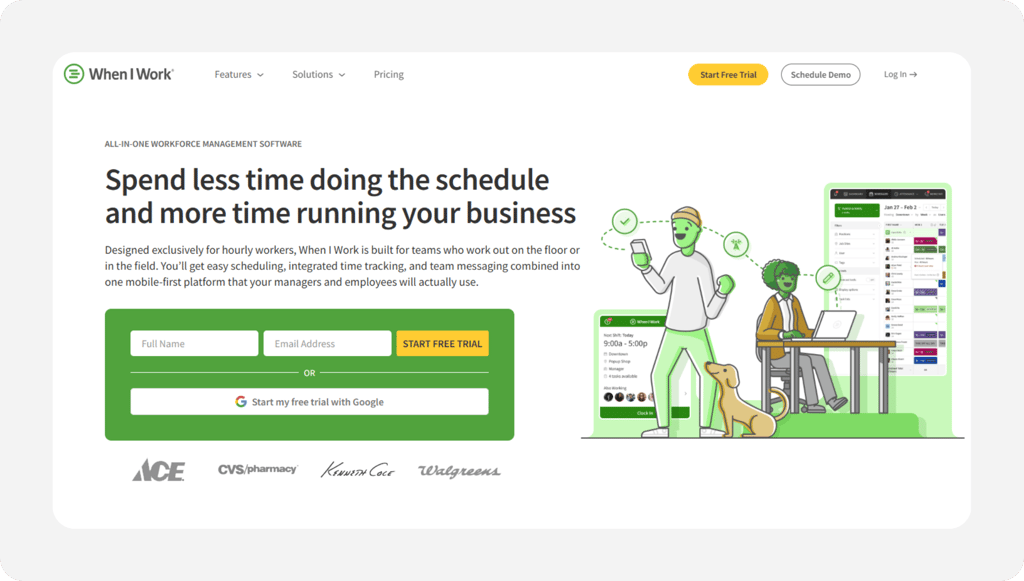
When I Work fits the leasing office that lives and dies by the shift calendar. Front desk and leasing agents swap coverage, fill open shifts, and message the team in one place, so a no-show gets covered fast. The buyer is the manager who builds a weekly schedule and wants the hours to follow it.
Its standout is scheduling speed, with auto-scheduling, shift swaps, and team messaging built in. Any device becomes a time clock with GPS and geofencing. The caution: time tracking and attendance is a paid add-on on top of the plan, so the clock you came for costs a little extra above the scheduling price.
Key Features
Pros
Cons
Pricing
- 14-day free trial, no credit card
- Essentials $2.50 per user a month, Pro $5 per user a month, Premium $8 per user a month; time tracking add-on from $1.50 per user a month

Buddy Punch: Best for Stopping Buddy Punching
Available on: Web, iOS, Android
Why Buddy Punch Is Best for Stopping Buddy Punching
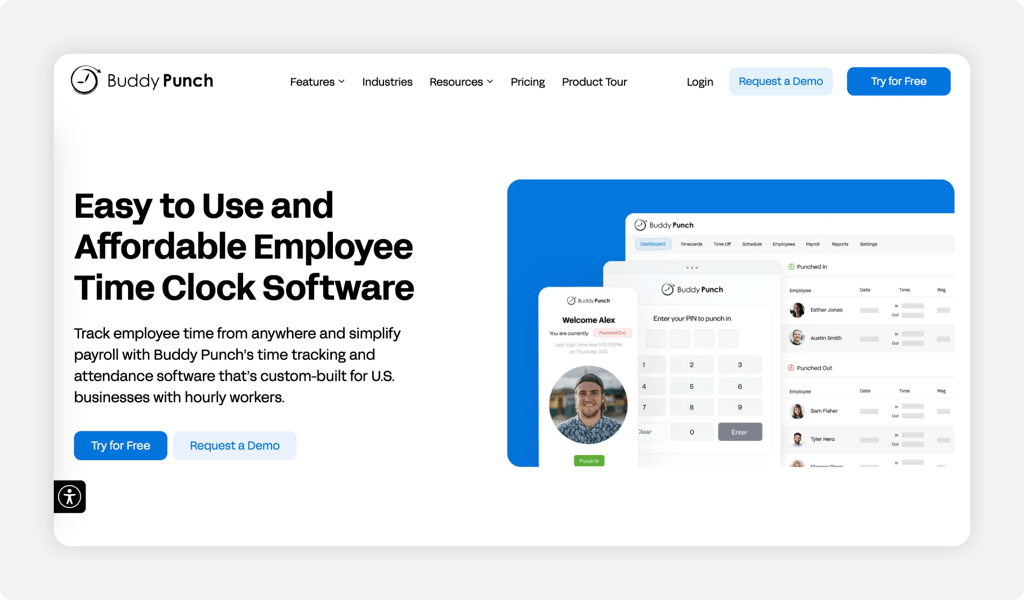
Buddy Punch fits the office where a shared front desk tablet tempts people to clock in for each other. The name says it all. Facial recognition matches the face to the employee profile, so a punch belongs to the person standing there. The buyer is the manager tired of paying for hours nobody worked.
Its standout is that verification layer, paired with a GPS stamp on every punch and a clean, simple interface. The caution is the base fee. Every plan carries a $19 base a month, which stings a small team, and on the Starter plan both GPS and scheduling are paid add-ons rather than included.
Key Features
Pros
Cons
Pricing
- 14-day free trial, no credit card
- Starter $5.49 per user a month, Pro $6.99 per user a month, Enterprise $11.99 per user a month, each plus a $19 base fee a month

Hubstaff: Best for Mobile Agents
Available on: Web, iOS, Android
Why Hubstaff Is Best for Mobile Agents
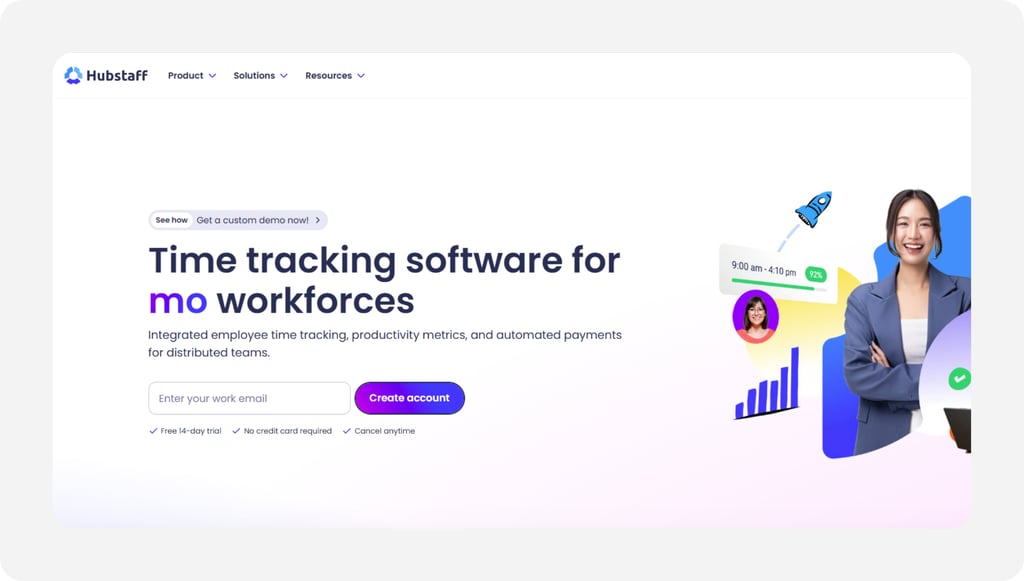
Hubstaff fits the real estate team whose agents are always on the move. It tracks time from a phone, drops a GPS stamp on every punch, and rolls a day of showings into hours you can bill or pay. The buyer is the broker who wants to see where the day went without calling anyone.
Its standout is the mix of GPS job sites, productivity insight, and built-in invoicing tied to project budgets, so a listing's hours and cost stay in one view. Here's the honest caution. GPS and scheduling only open up on the Grow plan, the productivity screenshots can feel like heavy monitoring to agents, and billing carries a two-seat minimum even for a solo office.
Key Features
Pros
Cons
Pricing
- 14-day free trial, no credit card
- Starter $4.99 per user a month (billed annually); GPS on the Grow plan at $7.50 per user
Side-by-Side Comparison
| Tool | Best For | Pricing | Key Strengths | Top Integrations |
|---|---|---|---|---|
| OnTheClock | Best for small real estate teams | $5 base + $4 per user a month | GPS geofencing, scheduling, PTO, mileage | Gusto, QuickBooks, ADP, Paychex |
| Timeero | Mileage tracking | $6 to $12 per user a month | Auto mileage, GPS breadcrumb, segmented tracking | QuickBooks, Gusto, ADP |
| Connecteam | Property maintenance crews | Free; paid from $29 a month (up to 30 users) | Time clock, forms, tasks, chat | QuickBooks, Gusto, Paychex |
| Homebase | Free single office | Free; paid $24 to $96 per location a month | Scheduling, time clock, hiring | Square, Gusto, QuickBooks |
| When I Work | Scheduling leasing staff | $2.50 to $8 per user a month (time add-on extra) | Scheduling, shift swaps, messaging | Gusto, QuickBooks, ADP |
| Buddy Punch | Stopping buddy punching | $5.49 per user + $19 base a month | Facial recognition, GPS punches | QuickBooks, Gusto, Paychex |
| Hubstaff | Mobile agents | $4.99 to $10/user | GPS job sites, productivity insight, invoicing | QuickBooks, Gusto, PayPal, Deel |
Comparison data verified June 2026 against each vendor's own site; subject to change by respective providers.
What's the Best Time Tracking Software for Real Estate?
The best option isn't the longest feature list; it's the one that fits how your team actually works. Start with the single question that bugs you most, then pick.
- Need GPS proof, scheduling, and mileage in one cheap plan? OnTheClock fits a small real estate team.
- Reimburse a lot of driving between properties? Timeero logs the miles for you.
- Running one office on no budget? Homebase has a real free plan.
The right tool removes friction from the problem you hit most, not the one a sales demo wants to show you.
What Is Real Estate Time Tracking Software?
Real estate time tracking software is a digital clock that records when your hourly staff start and stop work, and where. It replaces paper, spreadsheets, and texted hours with punches that carry a timestamp and a location.
For this audience, it adds the parts a desk clock skips: GPS that ties a punch to a property, mileage between stops, and a clean export to payroll. The simple point is honest hours you can prove.
Who Needs Time Tracking Software in Real Estate?
Any real estate business with hourly people who work away from one desk benefits. Brokerages with admins and leasing agents, property management firms with maintenance crews, and offices with a shared front desk all gain the most. The math changes once you pass a handful of staff or more than one property.
Think leasing offices, property management companies, real estate teams, and brokerage back offices. If you're chasing missing hours, fixing time sheets, or guessing at mileage, you're the audience.
Why Real Estate Teams Rely on Time Tracking Software
Real estate work spreads out, so accuracy protects your margin. Hours happen at listings, units, and closings, and a wrong number means a short paycheck, a payroll fix, or a compliance risk. Federal law backs this up: the Fair Labor Standards Act requires employers to keep accurate daily and weekly hours for every nonexempt worker.
The old way, paper and memory, breaks the moment a client questions a bill or an agent disputes a check. A real clock with location proof replaces the guesswork and gives you a record. See how OnTheClock handles time tracking with GPS for teams on the move.
Key Features Real Estate Time Tracking Software Should Have
Before you compare prices, make sure any tool covers the basics for a team that works across properties.
-
GPS and geofencing: ties a punch to the property and blocks clock-ins from the wrong spot.
-
Mileage tracking: logs drive time and miles between stops for reimbursement.
-
Punch verification: a photo, PIN, or facial check that stops buddy punching.
-
Mobile and kiosk punching: a phone clock for the field and a tablet for the office.
-
Scheduling and PTO: shift coverage for leasing staff plus time-off tracking.
-
Payroll export: clean hours that move into Gusto, QuickBooks, ADP, or your own payroll.
How to Choose the Proper Time Tracking Software for Real Estate
Step 1: Count your team and properties, then do the pricing math.
Start with real numbers. Count the hourly people you run in a busy week and the properties they cover, because per-user and per-location pricing decide your true cost, not the headline rate.
Run two quotes side by side. A six-person office on OnTheClock is $5 base plus six times $4, so $29 a month. The same team on a tool with a $19 base fee and a higher per-user rate can land near $60. Favor tools that bill only for active users, since real estate staffing swings with the season.
Step 2: Name the one problem that costs you most.
Pick one. Unproven hours across properties, untracked mileage, buddy punching, and payroll rework each point to a different tool, and chasing all four at once leads to an overbuilt plan you won't use.
Write the top problem down before you demo anything. If it's location proof, weight GPS and geofencing. If it's drive time, weight mileage. The named problem keeps a slick sales call from steering you toward features you don't need.
Step 3: Match the punch method to how your people work.
A roving agent needs a one-tap phone punch with GPS. A staffed front desk needs a tablet kiosk with a PIN or a photo. A maintenance tech needs a mobile clock that works at the unit.
Test the punch on your real devices before you roll it out. A clock that's clumsy on a phone gets skipped, and a skipped punch is the missing hour you'll hunt for on payday.
Step 4: Decide how much location proof you need.
Not every office needs a GPS breadcrumb on every punch. A single-office brokerage may only need a kiosk, while a property management firm covering 40 doors needs geofences at each one.
Ask to see the location report in the trial. Pull up a day, confirm each punch shows the right property, and check whether a wrong-location punch flags itself. That report is what answers a client or an auditor later.
Step 5: Handle drive time and mileage between properties.
Driving is the hidden cost in real estate. At the 2026 IRS rate of 72.5 cents a mile, an agent logging 500 miles a month is $362.50 in reimbursable mileage, and hand-tracked logs almost always undercount.
If your team drives a lot, weight automatic mileage capture heavily. A tool like Timeero logs the trip and the miles on its own, so the reimbursement matches reality instead of a rounded guess scribbled on a notepad.
Step 6: Check the payroll and accounting connection.
Trace one hour from punch to paycheck. Confirm the tool exports to the payroll you run, whether that's Gusto, QuickBooks, ADP, or Paychex, and run a test export during the trial.
If you keep your books in QuickBooks Online, a native sync saves a step, but it also assumes you pay for that subscription. A file that needs hand-editing every week is a hidden labor cost, so price that time in too.
Step 7: Run a full pay period on a free trial before you commit.
Put one office on the tool for a complete pay cycle, punch to payroll. Most of these picks offer a free trial, OnTheClock for 30 days with no credit card, so the test costs nothing but your attention.
Time the approvals, count missed punches, check how fast support answers, and add up the true monthly cost with your real head count. The tool that survives one honest payroll run is the one to buy.
Tips for Implementing Time Tracking Software at a Real Estate Business
-
Set geofences before you invite the team. Map each office and property first, so the very first punch already carries location proof.
-
Train on the phone, not just the desktop. Your field staff punch from a car or a doorstep, so walk them through the mobile app where they'll actually use it.
-
Keep records for the legal minimum. The U.S. Department of Labor's recordkeeping rules say to hold payroll records for three years and time cards for two, so pick a tool that stores history that long.
Frequently Asked Questions
What is the best time tracking software for real estate?
OnTheClock is the best time tracking software for small real estate teams. One plan at $5 base a month plus $4 per user covers GPS geofencing, scheduling, PTO, and mileage, with no features held back for a higher tier. Teams that drive a lot may prefer Timeero for automatic mileage, while a single office on a budget can start free on Homebase.
How do real estate teams track hours across multiple properties?
They use a mobile time clock with GPS and geofencing. Each punch carries a location, so the system records which property a person worked and when, even though no manager is standing there. OnTheClock, Timeero, and Connecteam all tie punches to a property, which gives you a record to answer a client question or a payroll dispute.
Is there free time tracking software for a real estate office?
Yes. Homebase offers a free Basic plan for one location with up to 10 employees, including scheduling and clock-in on phones and tablets. Connecteam is free for up to 10 users with its time clock included. Both work well for a single small office, though location-based punches and multilocation features move you to a paid plan.
Can time tracking software track agent mileage between properties?
Yes. Timeero logs drive time and miles automatically with a GPS breadcrumb, and OnTheClock tracks mileage alongside hours in its base plan. At the 2026 IRS rate of 72.5 cents a mile, automatic capture matters because hand-written logs almost always undercount the real distance driven between showings and units.
How much does time tracking software for real estate cost?
Most tools charge a per-user rate, sometimes with a base fee. OnTheClock is $5 base a month plus $4 per user. Timeero runs $6 to $12 per user a month, and Hubstaff runs $4.99 to $10 per user a month with a two-user minimum. Homebase and Connecteam both offer a free plan for a small single-office team.
Does real estate time tracking software connect to payroll?
Yes. OnTheClock exports to Gusto, QuickBooks, ADP, Paychex, and SurePayroll, and offers its own payroll add-on for a $40 base plus $6 per employee. Hubstaff connects to QuickBooks, Gusto, PayPal, and Deel, and Homebase connects to popular payroll providers. Clean exports keep the same hours feeding both pay and your labor numbers.
Stop guessing who worked which property.
Track hours, prove locations, and run clean payroll for your real estate team with OnTheClock.
No credit card required, and you'll be set up in minutes.