

Jump to section
Try OnTheClock Free
Save time and make payroll effortless with our easy-to-use, affordable employee time tracking app.
Try It FreeKey Takeaways
- ✔OnTheClock is the best pick for small retail shops. One plan at $5 a month plus $4 per user covers photo punches, scheduling, PTO, and overtime alerts.
- ✔A shared register invites buddy punching. A photo or PIN at clock-in stops one associate from punching in for another.
- ✔Part-time and seasonal staff churn fast. Pick a tool that bills only for active users so a slow January doesn't cost you.
- ✔The holiday rush stacks overtime quietly. Daily and weekly alerts catch the 40-hour line before payday, not after.
- ✔Run two real quotes before you buy. Per-user math and the base fee decide your true monthly cost, not the headline rate.
For a retail store, the best time tracking software does three things: it proves who actually worked the floor, it stops one associate from punching in for another, and it turns a week of shifts into one clean paycheck. Get those three right, and payroll night stops being a guessing game.
It's 9:40 p.m. on a Saturday, and Renee just locked the register after the biggest sale weekend of the spring. She pulls the punch report and frowns. One associate is clocked in for a 12-hour day she knows didn't happen, because a teammate tapped the shared tablet for her before the doors even opened. Now Renee has to rebuild the day from memory, texts, and the schedule she printed Thursday. Multiply that by every store and every week, and the small leaks turn into real money. Reviewers on G2 and Capterra keep raising the same three pains: associates punching in for each other at a shared register, hours they can't track cleanly across more than one store, and missed punches that wreck payroll.
No single tool wins for every store. Below are seven picks, each matched to a real situation, starting with the one for small retail shops.
What Retailers Actually Want From Time Tracking
Retailers want honest hours first. A sales floor runs on part-time and seasonal staff who share one clock, so the punch has to belong to the person standing there. That single need shapes almost every other choice on this list.
They also want hours that move cleanly into pay. A schedule shifts week to week, the holiday rush stacks overtime, and a wrong number means a short paycheck and an angry associate on Monday. A simple punch plus a clean export to payroll keeps both sides honest before anyone gets paid.
And they want it fast at the counter. Your team clocks in between customers, so the punch has to be one tap on a phone or a quick PIN on the front counter tablet. The right pick shifts with whichever of these you feel most.
Quick Picks: The Best Time Tracking Software for Retail at a Glance
-
OnTheClock: Best for small retail shops
-
Homebase: Best free option for a single store
-
When I Work: Best for easy shift swaps
-
Deputy: Best for multilocation retail chains
-
Connecteam: Best for all-in-one retail teams
-
Buddy Punch: Best for stopping buddy punching at the register
-
Jibble: Best free time tracking plan
How We Evaluated the Best Time Tracking Software for Retail
We judged each tool on what actually matters behind a busy counter, not on feature-sheet length. We compared every option against the eight needs retailers keep raising, what we call the OnTheClock Retail Checklist:
-
Punch verification: photo, PIN, or facial recognition that stops buddy punching at a shared register.
-
Fast counter punching: a one-tap phone clock or a front counter tablet kiosk.
-
Multistore visibility: who's working right now across every location, in one view.
-
Scheduling and swaps: build the week and let staff trade shifts without a group text.
-
Overtime alerts: daily and weekly flags that catch FLSA overtime during the holiday rush.
-
Seasonal flexibility: add and drop part-time staff without paying for empty seats.
-
Clean payroll export: hours that leave the system ready for pay and your POS.
-
Total cost: the real base fee plus per-user math as your headcount swings.
OnTheClock earns the small-shop slot here because it covers the whole checklist in one base plan: photo and location punch controls, kiosk and mobile punching, scheduling, PTO, and overtime alerts, with none of it held back for a higher tier. That breadth at $5 base plus $4 per user is the basis for the small-shop label, not a ranking against the other picks. Each tool below serves its own situation best.
The Best Time Tracking Software for Retail
Below, the best time tracking software for retail, with the right pick for each situation. For each one, we cover who it fits best, where it stands out, and where it may not be the right move.

OnTheClock: Best for Small Retail Shops
Available on: Web, iOS, Android
Why OnTheClock Is Best for Small Retail Shops
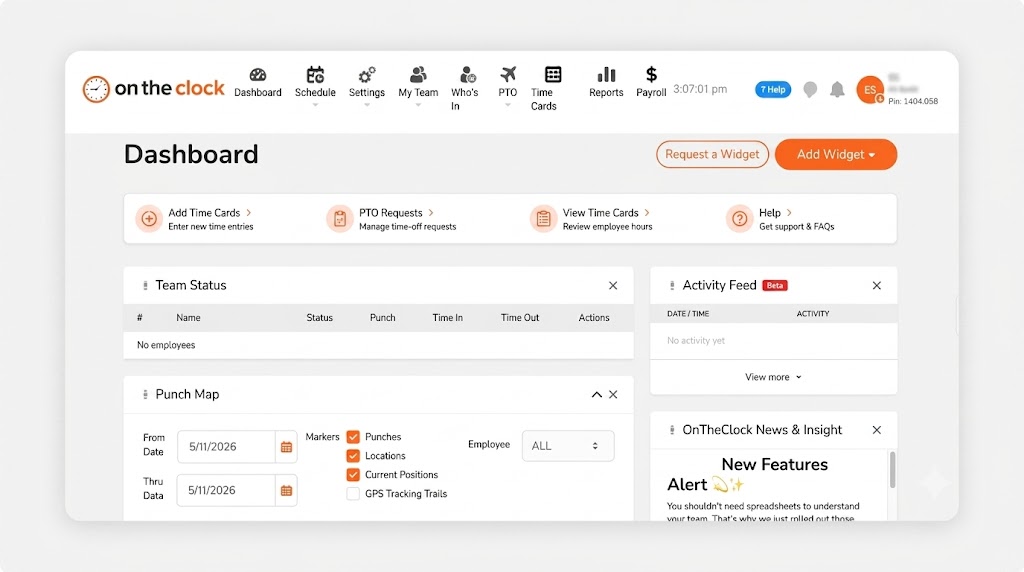
OnTheClock fits the lean shop that runs one or two storefronts and a small crew. Picture a six-person boutique with a front counter tablet and a few phones. The owner needs an honest punch, a quick way to see who's on the floor, and a clean payroll file, not a platform that takes a week to learn. OnTheClock gives an associate a punch button on their own phone, can snap a photo at clock-in, and shows the office who's working in minutes.
It covers the full checklist in the base plan. Photo capture, GPS, and IP rules confirm the right person punched in. Kiosk mode with a PIN handles the shared counter tablet. Scheduling fills the weekend and holiday shifts, overtime alerts flag the 40-hour line, and punch reminders catch an associate who forgot to clock in during a rush. Reviewers single out the support team, who answer by phone, chat, or email without a wait, which matters most on payroll night.
Why OnTheClock Is Different
One plan, no fine print. You pay a $5 base a month plus $4 per user, and the location controls, scheduling, PTO, and overtime tools are all included, not gated behind a pricier tier. For a 10-person store, that's $45 a month with every feature on. Need pay runs in the same place? Add OnTheClock Payroll for a $40 base a month plus $6 per employee.
It stays honest about the trade-off. Punches need an internet or Wi-Fi connection, so a pop-up booth with no signal needs the offline workaround or a counter kiosk. Stores that want deep custom dashboards may find the reporting lighter than a heavy enterprise suite. For most small retail teams, the simple, low cost is the point. It integrates with Gusto, QuickBooks, ADP, Paychex, and SurePayroll for the rest.
Key Features
Pros
Cons
Pricing
- 30-day free trial, no credit card
- $5/month base plus $4 per user/month (see how OnTheClock pricing works)

Homebase: Best Free Option for a Single Store
Available on: Web, iOS, Android
Why Homebase Is Best Free for a Single Store
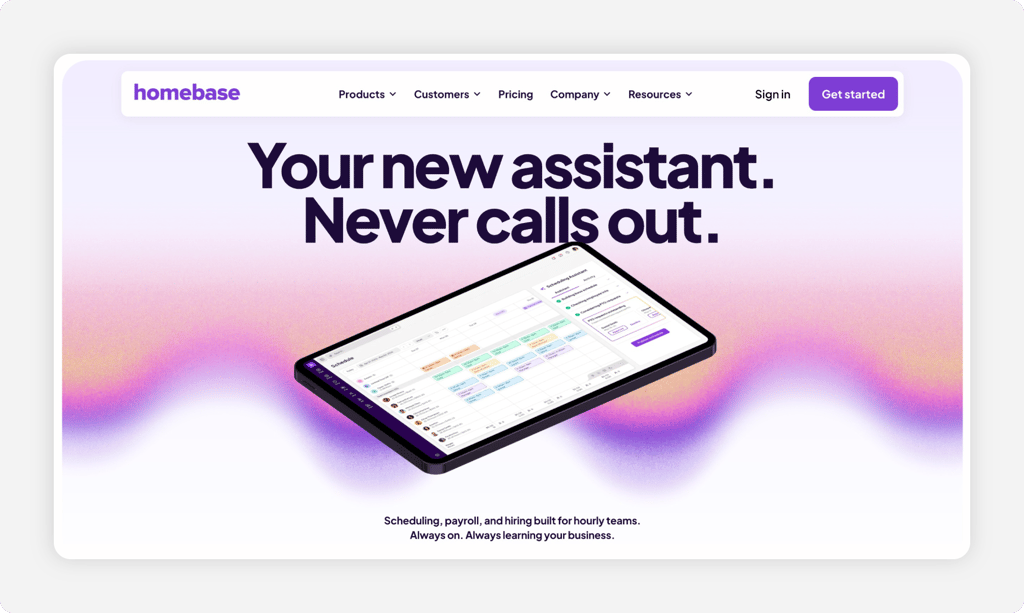
Homebase fits the one-location shop that wants to spend nothing to start. The free Basic plan covers one location and up to 10 employees, with scheduling, time tracking, and clock-in on tablets, computers, and POS devices. For a small store testing the water, that's a real tool at zero cost, not a stripped trial.
It stands out for retail because it plugs straight into the register. Homebase connects to Square, Clover, and other point-of-sale systems, so the same device that rings up a sale can clock in the team. One caution is the free tier's ceiling. Location-based clock-in and photo punches sit on the paid Essentials plan, and the moment you add a second store you move to a per-location fee.
Key Features
Pros
Cons
Pricing
- Free Basic plan for one location, up to 10 employees
- Paid plans $30 to $120 per location a month; payroll add-on $39 base plus $6 per employee

When I Work: Best for Easy Shift Swaps
Available on: Web, iOS, Android
Why When I Work Is Best for Easy Shift Swaps
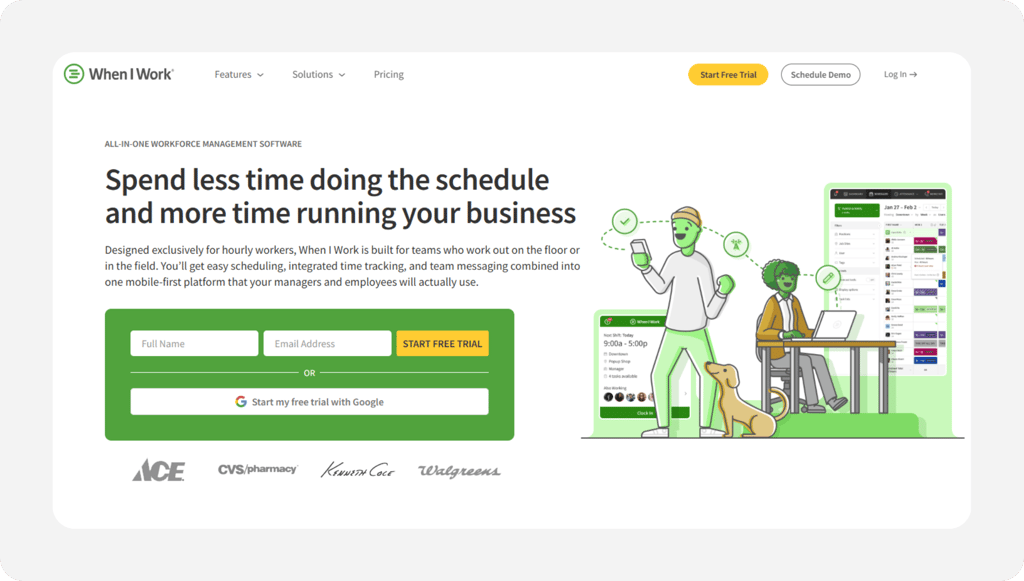
When I Work fits the store where the schedule never sits still. Associates call out, swap shifts, and pick up extra hours, and this tool makes that simple. Staff trade and claim open shifts from the app, and the manager approves with a tap, so a Friday no-show doesn't turn into a scramble.
It builds the schedule fast and shares it instantly, which is the real draw. One caution is the punch clock. Time tracking and attendance ride on top of the scheduling plan as a paid add-on, so the time clock costs extra per user on top of the base price. If you mainly need a schedule with a clock attached, that math still works. See our honest When I Work review for the full breakdown.
Key Features
Pros
Cons
Pricing
- 14-day free trial, no credit card
- $2.50 to $8 per user a month; time tracking add-on from $1.50 per user a month

Deputy: Best for Multilocation Retail Chains
Available on: Web, iOS, Android

Why Deputy Is Best for Multilocation Retail Chains
Deputy fits the chain running several stores under one office. It auto-builds schedules, fills open shifts, and tracks labor against sales across every location, so a regional manager sees the whole picture in one place. For a growing brand with five or 10 stores, that control is the selling point.
Its tablet kiosk adds a face-unlock biometric punch on the Core plan, which cuts buddy punching at a shared register. One caution is the floor. Deputy carries a $30 monthly minimum and the biometric clock sits above the entry Lite tier, so a tiny single store pays more than it needs. Compare the options in our Deputy alternatives guide.
Key Features
Pros
Cons
Pricing
- 31-day free trial, no credit card
- $5 per user a month Lite, $6.50 Core, $9 Pro; $30 monthly minimum

Connecteam: Best for All-in-One Retail Teams
Available on: Web, iOS, Android
Why Connecteam Is Best for All-in-One Retail Teams
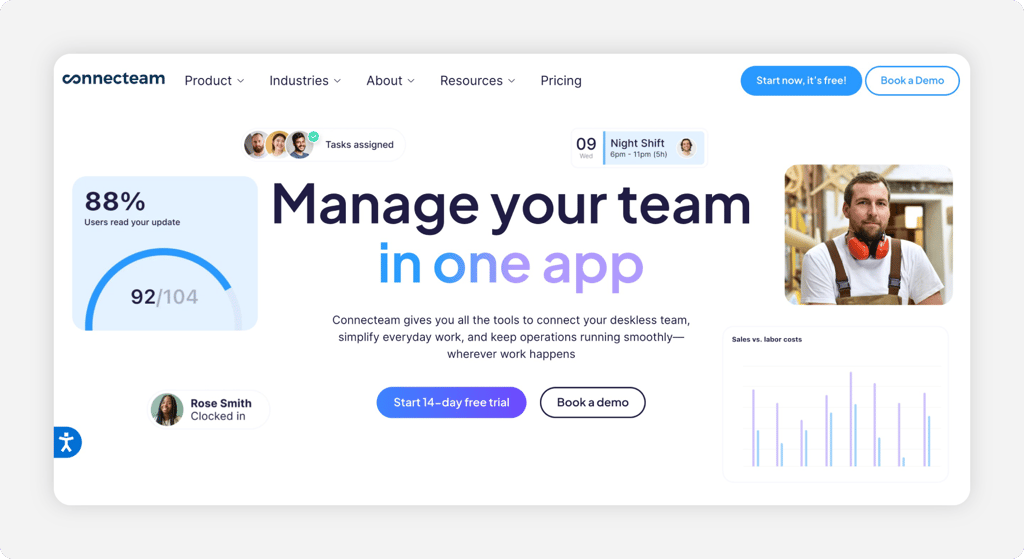
Connecteam fits the store that wants more than a clock. It pairs a GPS time clock with team chat, task lists, training, and checklists, so a manager can clock the team, assign the morning restock, and message the floor from one app. For a busy retail crew, that all-in-one reach saves juggling tools.
Small teams clock in free. The Small Business plan is free for life for up to 10 users, with the time clock included. One caution is the jump above that. Geofencing and the deeper controls sit on the paid Advanced tier, and paid plans price by tiers of up to 30 users, so a midsize store pays for the band, not the exact head count.
Key Features
Pros
Cons
Pricing
- Free for life for up to 10 users
- Paid Operations plans $29 to $99 a month for the first 30 users

Buddy Punch: Best for Stopping Buddy Punching at the Register
Available on: Web, iOS, Android
Why Buddy Punch Is Best for Stopping Buddy Punching
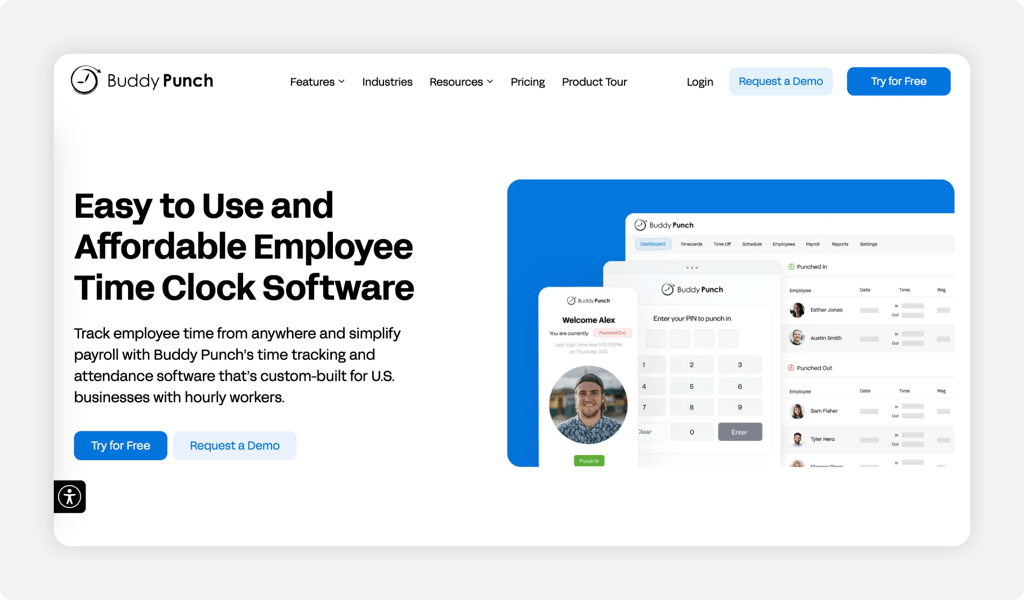
Buddy Punch fits the store where a shared register tempts time theft. It snaps a webcam photo on every punch and offers facial recognition that matches the clock-in face to the employee profile. When an associate tries to punch in for a teammate, the photo or the face check catches it, which is exactly the leak the name calls out.
It keeps the clock simple and the controls tight. One caution is the base fee on a small crew. Every plan adds a $19 base a month on top of the per-user rate, and kiosk, QR, and geofencing features sit on the Pro tier, so a three-person shop pays a premium for the lighter plan. Our Buddy Punch alternatives guide weighs the trade-offs.
Key Features
Pros
Cons
Pricing
- 14-day free trial, no credit card
-
$4.99 to $12.99 per user/month when billed annually, plus a $19/month base fee
Jibble: Best Free Option
Available on: Web, iOS, Android
Why Jibble Is the Best Free Option
Jibble is the pick for a store that wants a real time clock without a bill. It's free forever for unlimited people, so a full floor crew can clock in and out at no cost. The buyer is the store owner or manager who needs accurate hours but has no software budget.
Its standout is the free plan paired with face recognition and GPS, so each punch ties to a real person at a real register. The honest caution is there's no built-in payroll, so you export hours to Gusto, QuickBooks, ADP, or Xero instead of running pay inside the app. The free plan also caps you at two geofences, and custom policies need a paid plan.
Key Features
Pros
Cons
Pricing
- Free forever for unlimited users
- Premium from $4.99 per user a month; Ultimate $7.99 per user a month
Side-by-Side Comparison
| Tool | Best For | Pricing | Key Strengths | Top Integrations |
|---|---|---|---|---|
| OnTheClock | Best for small retail shops | $5 base + $4/user | Photo punch, scheduling, overtime alerts | Gusto, QuickBooks, ADP, Paychex |
| Homebase | Free for a single store | Free; paid $30+/location | POS clock-in, free single-store plan | Square, Clover, QuickBooks, Gusto |
| When I Work | Easy shift swaps | From $2.50/user; clock add-on | Shift swaps, fast scheduling | QuickBooks, Gusto, Rippling |
| Deputy | Multilocation chains | From $5/user; $30 minimum | Auto-scheduling, biometric kiosk | Square, QuickBooks, Gusto, ADP |
| Connecteam | All-in-one retail teams | Free to 10; $29+ monthly | Clock, chat, tasks in one app | QuickBooks, Gusto, Paychex |
| Buddy Punch | Stopping buddy punching | $19 base + $4.99/user | Photo and facial recognition punches | QuickBooks, Gusto, Paychex |
| Jibble | Free time tracking | Free; paid from $4.99/user | Face recognition, GPS, geofence clock-in | QuickBooks, Xero, Gusto, ADP |
Comparison data verified October 2026 against each vendor's own site; subject to change by respective providers.
What's the Best Time Tracking Software for Retail?
The best option isn't the longest feature list; it's the one that fixes the friction you hit most. Start with one question: where does your store leak time today?
- Want every feature in one cheap plan? OnTheClock covers the whole checklist at $5 base plus $4 per user.
- Running one store on a tight budget? Homebase is free for a single location.
- Fighting buddy punching at a shared register? Buddy Punch matches the face to the punch.
Name the leak first. The right tool then picks itself.
What Is Retail Time Tracking Software?
Retail time tracking software records when your store staff clock in and out, then turns those punches into accurate hours for payroll. It replaces paper sheets and register guesswork with a phone punch, a tablet kiosk, or a POS clock-in that stamps each shift.
For a store, it adds the controls a sales floor needs. Photo or PIN punches confirm the right person clocked in, scheduling fills the weekend rush, and overtime alerts flag the 40-hour line. The point is simple. You pay for the hours your team actually worked, no more and no less.
Who Needs Time Tracking Software in Retail?
Any store with hourly staff benefits, and the math changes fast past a few employees. A single owner ringing the register alone may not need it. The moment you schedule even three or four part-timers on a shared clock, manual tracking starts costing you in padded minutes and payroll fixes.
Boutiques, convenience stores, specialty shops, and multistore chains all land in the audience. If you're chasing missed punches, splitting hours across two locations, or rebuilding a week from texts, you're the audience, and a simple clock pays for itself quickly.
Why Retail Stores Rely on Time Tracking Software
Retail runs on thin margins and a rotating cast of part-time staff. Every padded minute and every buddy punch comes straight off the bottom line, and a busy floor gives those leaks plenty of cover. Accurate hours protect the margin you fight for on each sale.
The old way fails because it trusts memory. A paper sheet or a register note can't prove who stood the floor, and it can't catch overtime before payday. A real clock with GPS and location controls replaces the guesswork with a record you can stand behind when an associate questions a paycheck.
Key Features Retail Time Tracking Software Should Have
Before comparing prices, make sure any tool covers the retail basics. These are the features a sales floor actually leans on.
-
Punch verification: a photo, PIN, or face check that ties the punch to the real person.
-
Counter kiosk and mobile punch: a tablet at the register and a phone clock for the floor.
-
Scheduling and swaps: build the week and let staff trade shifts without a group text.
-
Overtime alerts: daily and weekly flags that warn you before the holiday rush blows the budget.
-
Multistore view: who's working right now across every location, in one screen.
-
Payroll and POS export: hours that leave the system clean for pay and your register data.
How to Choose the Proper Time Tracking Software for Retail
Step 1: Count your stores and staff, then do the pricing math. Start with real numbers. Count the associates you run in a busy week and the locations they cover, because per-user pricing decides your true cost, not the headline rate.
Run two quotes side by side. A 12-person store on OnTheClock pays a $5 base plus $4 per user, or $53 a month, with every feature on. A free tool like Jibble tracks the same 12 staff at no cost, no matter how the head count shifts.
Now factor churn. Retail adds and drops seasonal staff constantly, so favor tools that bill only for active users and let you deactivate a worker without a penalty.
Step 2: Name the single problem that costs you most. Pick one. Buddy punching, missed punches, and multistore blind spots each point to a different tool, and chasing all three at once leads to an overbuilt plan you won't use.
Be honest about the dollars. If an associate pads six minutes a shift across 15 part-timers at $15 an hour, that's about $675 a month gone. If two stores keep drifting on hours, a single dashboard is your lever.
Write the top problem down before you demo anything. It keeps a slick sales call from selling you features that don't fix your leak.
Step 3: Match the punch method to your sales floor. A roving associate needs a one-tap phone punch. A front counter needs a tablet kiosk with a PIN. A pop-up booth with weak signal may need an offline punch that syncs later.
Most stores mix two methods. OnTheClock, Homebase, and Buddy Punch all support a counter kiosk and a phone clock, so one account can cover the register and the floor at once.
Test the punch on your real counter tablet before you roll it out. The device that lags during a checkout line is the one that creates the missed punch you're trying to prevent.
Step 4: Lock down buddy punching at the shared register. This is the retail-specific step. A shared clock is the easiest place for time theft, because one associate can tap in for a friend who's running late.
Confirm how each tool proves identity. OnTheClock can snap a photo at clock-in, Buddy Punch adds facial recognition that matches the face to the profile, and Deputy uses a face-unlock kiosk on its Core plan. Ask to see the verification in the trial.
Run one shift through it. If the report shows a photo or a face match on every punch, you've closed the most common leak.
Step 5: Get one view across every store. A chain lives or dies on visibility. When you run more than one location, you need to see who's clocked in everywhere without calling each manager.
Decide how much it matters. If you run three or more stores, Deputy and Connecteam both show live status across locations, while OnTheClock's "who's in" dashboard covers a small two-store setup cleanly.
Pull a multistore report in the trial. A clear cross-location view today saves a dozen phone calls every week.
Step 6: Pre-configure overtime and break rules before the holiday rush. Overtime errors are the most common payroll complaint reviewers raise. The November and December crunch pushes part-timers past 40 hours fast, and the Fair Labor Standards Act requires at least time and a half for those hours, per the U.S. Department of Labor.
Set the rules before payday, not after. A tool with daily and weekly overtime alerts, like OnTheClock, warns you while you can still adjust a schedule rather than eat the cost.
Map your state rules too. Some states add daily overtime past eight hours or require paid breaks, so confirm the software can hold both the federal and the state line for nonexempt staff.
Step 7: Confirm the payroll and POS export path. Trace one hour from punch to paycheck. The hours have to leave the system clean, because a wrong number here pays an associate wrong and throws off your labor numbers at the same time.
Check the named integrations. OnTheClock exports to Gusto, QuickBooks, ADP, Paychex, and SurePayroll, Homebase connects to Square and Clover registers, and Jibble exports approved hours to QuickBooks, Xero, Gusto, and ADP. If you want pay in the same tool, OnTheClock Payroll adds it for a $40 base plus $6 per employee.
Run a test export during the trial. A file that needs hand-editing every week is a hidden labor cost no demo will mention.
Step 8: Test the tool through a full pay period before you commit. A 14-day or 30-day trial only proves something if you run real punches through it. Put one store on it for a complete pay cycle, punch to payroll.
Watch the rough edges. Time how long approvals take, count the missed punches, and check whether support answers fast when a punch goes wrong on payroll night.
Then add up the true monthly cost with your real head count. The right tool feels boring by the end of the trial, because nothing broke.
Tips for Implementing Time Tracking Software in a Retail Store
-
Train your shift leads first. Show each key holder the punch and approval flow before go-live, so they can coach their own associates on day one instead of calling the office.
-
Set the counter kiosk up early. Mount the tablet and test a PIN or photo punch before opening, so the first clock-in already carries the proof you want.
-
Lock overtime and break rules from the start. Configure them before your first payroll run and check them against the federal overtime standard, so the export comes out clean.
Frequently Asked Questions
What is the best time tracking software for retail?
OnTheClock is the best time tracking software for small retail shops. One plan at $5 base a month plus $4 per user covers photo punches, kiosk mode, scheduling, and overtime alerts, with no features held back for a higher tier. Larger chains may prefer Deputy for multistore scheduling, while a single store on a budget can start free on Homebase.
How do I stop associates from buddy punching at the register?
Use a punch method that proves identity. A photo, PIN, or facial recognition check at clock-in stops one associate from punching in for another. OnTheClock snaps a photo at clock-in, Buddy Punch matches the face to the employee profile, and Deputy offers a face-unlock kiosk. On a shared register, that one step shuts down the most common form of time theft.
Is there free time tracking software for a retail store?
Yes. Homebase offers a free Basic plan for one location with up to 10 employees, including scheduling and clock-in on tablets and POS devices. Connecteam is free for life for up to 10 users with its time clock included. Both work well for a single small store, though location-based punches and multistore features move you to a paid plan.
How does retail time tracking software handle overtime?
Good software ties each punch to the schedule and counts hours as they add up. Daily and weekly overtime alerts flag the 40-hour line before payday, which matters because the FLSA requires at least time and a half past 40 hours. OnTheClock and Deputy both watch the overtime line, so the holiday rush doesn't turn into a payroll surprise for nonexempt staff.
How much does time tracking software for retail cost?
Most tools charge a base fee plus a per-user rate. OnTheClock is $5 base a month plus $4 per user. Deputy starts at $5 per user with a $30 monthly minimum, while Jibble is free forever for unlimited users. Homebase and Connecteam both offer a free plan for a small single-location team.
Does retail time tracking software connect to my POS and payroll?
Yes. OnTheClock exports to Gusto, QuickBooks, ADP, Paychex, and SurePayroll, and offers its own payroll add-on for a $40 base plus $6 per employee. Homebase connects to Square and Clover registers, and Jibble exports hours to QuickBooks, Xero, Gusto, and ADP. Clean exports keep the same hours feeding both pay and your store's labor numbers.
Track Every Shift With Honest Hours
Stop rebuilding payroll from memory and texts. Give your retail team photo-verified punches that stop buddy punching and export clean to payroll.
No credit card required, and you'll be set up in minutes.