


Jump to section
Try OnTheClock Free
Save time and make payroll effortless with our easy-to-use, affordable employee time tracking app.
Try It FreeA leap year alone doesn't create a 27th paycheck. A biweekly payroll gets 27 paydays when its first payday lands on Jan. 1 (or Jan. 2 in a leap year), or when a Jan. 1 payday is moved up into December. That happens about once every 11 years per schedule.
In 2026, that's Thursday payers whose first payday was Jan. 1, plus Friday payers who move their Jan. 1, 2027, payday up to Dec. 31, 2026.
Quick answers
- 2026: Thursday biweekly schedules that started with a Jan. 1 payday have 27 paydays. Friday schedules also have 27 if the Jan. 1, 2027, payday is moved up to Dec. 31, 2026.
- 2027: Biweekly schedules with a Friday payday that starts on Jan. 1, 2027, have 27, unless that holiday payday moves up to Dec. 31, 2026.
- 2028 (leap year): The leap day doesn't add a 27th payday. Only Monday payers who move their Jan. 1, 2029, payday up to Dec. 29, 2028, get one.
- Next leap year that adds one: 2032, for Friday paydays. Thursday payers also get 27 in 2032 if they pay their Jan. 1 payday after the holiday.
Why Some Years Have 27 Pay Periods
A biweekly payroll runs every 14 days, and 26 × 14 = 364. A regular year has 365 days, and a leap year has 366. That leaves one or two extra days every year, so your paydays creep about a day earlier on the calendar each year.
Eventually your first payday of the year lands so early in January that 26 more two-week periods still fit before Dec. 31. That gives you a 27th payday. A Friday schedule in 2026 shows how it works:
- First payday: Friday, Jan. 2, 2026
- 26th payday: Friday, Dec. 18, 2026
- Next scheduled payday: Friday, Jan. 1, 2027, a bank holiday. Paid on Thursday, Dec. 31, 2026, it becomes the 27th payday of 2026.
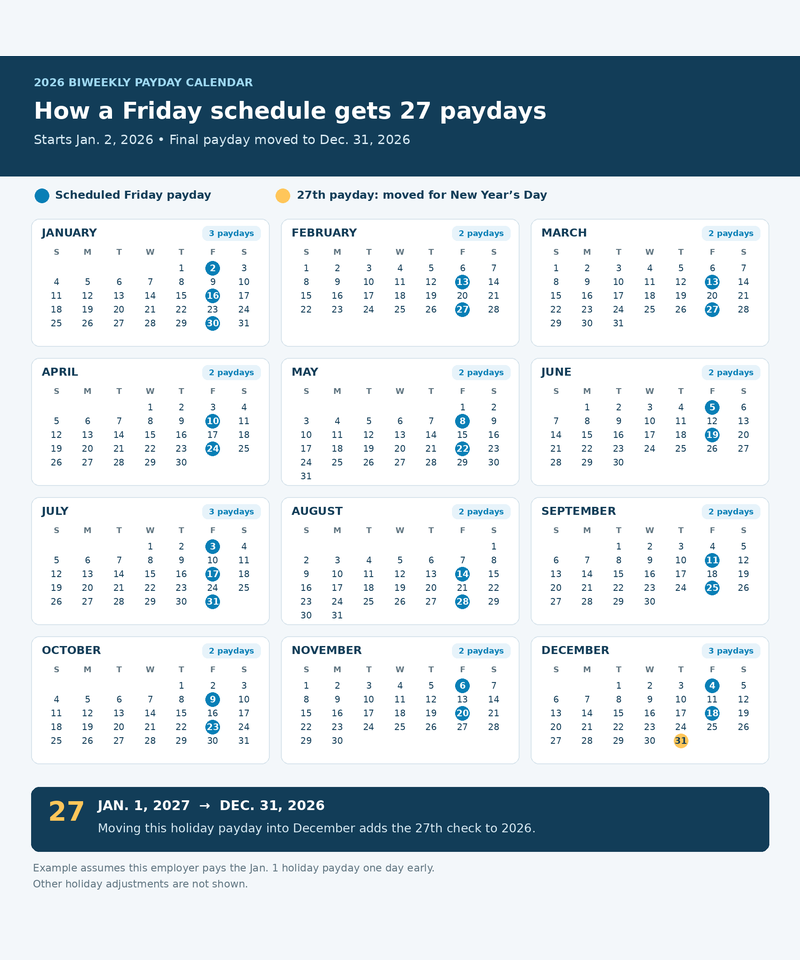
According to the Government Finance Officers Association (GFOA), those leftover days add up to about 0.0893 extra pay periods per year. That works out to a 27th payroll roughly once every 11 years for any one biweekly schedule.
A leap year speeds up the drift by one day, so it can be the year that tips a schedule over. It's rarely the whole reason, though.
Weekly payroll works the same way. 52 × 7 = 364, so weekly schedules get a 53rd payday about every five to six years. Weekly payers can use the same table below.
Which Years Have 27 Biweekly Pay Periods (2026–2032)
Find your payday weekday. Which year gets the 27th payday depends on what you do when a payday falls on New Year's Day.
| Year | Leap year? | Payday weekday that gets 27 paydays | |
|---|---|---|---|
| Jan. 1 payday moved up to December |
Jan. 1 payday paid after the holiday |
||
| 2026 | No | Friday | Thursday |
| 2027 | No | None | Friday |
| 2028 | Yes | Monday | None |
| 2029 | No | Tuesday | Monday |
| 2030 | No | Wednesday | Tuesday |
| 2031 | No | Thursday | Wednesday |
| 2032 | Yes | Friday | Thursday or Friday |
Weekly payroll: the same weekdays get 53 paydays.
Quick self-check: Take your first payday of the year and add 364 days (26 × 14). If that date, after any holiday adjustment, still falls in the same calendar year, you have 27 pay periods. The year a payday is actually paid is the year it counts for payroll taxes and W-2s.
Does the 2028 Leap Year Add a Paycheck?
Not because of the leap day. Jan. 1, 2028, is a Saturday and Jan. 2 is a Sunday, so the extra day in February doesn't give any weekday biweekly schedule a 27th payday.
There's one exception, and it comes from the New Year's holiday. Monday payers whose Jan. 1, 2029, payday moves up to Friday, Dec. 29, 2028, will process 27 paydays in 2028.
The next leap year where Feb. 29 adds a paycheck is 2032, for Friday payers whose first payday is Friday, Jan. 2, 2032.
How to Handle a 27th Pay Period
Hourly employees are simply paid for the hours they work, so a 27th payday doesn't change their pay rate. The decision is about salaried employees. You have three options, and they carry very different compliance risks.
Option 1: Divide Annual Salary by 27
Spread each salaried employee's annual pay across 27 checks instead of 26 (or 53 instead of 52 for weekly payroll). A $52,000 salary becomes $1,925.93 per check instead of $2,000.
If the year is already underway, recalculate the remaining checks:
(Annual salary − amount already paid this year) ÷ remaining paychecks = new per-check amount
- Pros: Annual salary costs stay on budget.
- Cons: Each paycheck is smaller, which employees will notice. Employers should also confirm that any change in payroll calculations complies with federal and state salary-basis requirements.
Fair Labor Standards Act (FLSA) warning: Changing the number of paydays does not by itself change an employee's annual salary or exempt status. However, exempt employees generally must satisfy the federal salary-basis and salary-level requirements, and some states impose higher thresholds. Review any change to an exempt employee's pay structure with your payroll provider or employment counsel before implementing it.
Option 2: Pay the Extra Paycheck
Keep every check the same, and pay the 27th as a normal payday.
- Pros: It's the simplest option. Employees' regular paycheck amounts stay the same, and employees generally like it.
- Cons: Salaried payroll costs about 3.85% more that year (one extra check ÷ 26). For a $52,000 employee, that's an extra $2,000, plus the employer payroll taxes on it.
Option 3: Reduce the Final Paycheck (Proceed With Caution)
Some employers pay 26 regular checks, then shrink or skip the 27th to keep annual pay flat.
- Pros: Annual cost stays flat without changing every check.
- Cons: It's risky for exempt employees. Under the FLSA's salary basis rule, exempt employees must receive their full salary for any week they work. A smaller or missing check for two weeks of work can break that rule. If you're considering this option, talk with your payroll provider or employment counsel first.
Don't forget benefits, deductions, and the budget:
- Per-paycheck deductions: Health premiums and Section 125 deductions are often set up for 26 checks. Either suppress them on the 27th check or re-divide them across 27, so employees aren't overcharged.
- 401(k) and health savings account (HSA) contributions: Flat per-check contributions get one extra deposit. That can push an employee past an annual limit or overfund their election, so set up a cap or a true-up.
- Paid time off (PTO) accruals: If PTO accrues per pay period, a 27th payday adds an extra accrual. Decide whether that's intended.
- Budget timing: A calendar-year budget takes the full cost of the extra payroll. If your fiscal year runs, say, May to April, check which fiscal year the 27th payday falls in.
Tell Employees Before the Extra Payday Arrives
Whichever option you choose, employees should hear it from you before they notice it on a pay stub. A smaller check that nobody explained feels like a pay cut. An extra check that nobody mentioned can cause confusion at tax time.
Timeline:
- Q4 of the year before: Announce your plan before the year with 27 paydays begins. If your 27th payday comes from a Jan. 1 payday that moves up to Dec. 31, tell employees now, since it lands this year.
- Just before the change: If you're dividing salary by 27, remind employees one pay period before the new amount starts.
- At W-2 time: If you chose to pay an additional full paycheck rather than divide the annual salary across 27 checks, employees may see higher W-2 wages than their stated annual salary. Explain the difference so they understand why.
What to include:
- Which option you chose and why
- What changes on each paycheck, with a sample amount
- Whether annual salary changes (with Option 1, it doesn't)
- How benefit deductions and retirement contributions will be handled
- For exempt employees on Option 1: explain that the change affects paycheck amounts, not their stated annual salary
A sample note to employees:
This year, our biweekly payroll has 27 paydays instead of the usual 26. Because of how the calendar falls, this happens about once every 11 years. To keep your annual salary the same, we'll divide it across 27 checks starting [date], so each check will be slightly smaller. Your annual salary and benefits are not changing. Questions? Contact [name].
If you choose to pay the extra check, the note is even easier, and it's good news.
What About Hourly, Semimonthly, and Monthly Employees?
Hourly Employees
Hourly employees on a biweekly schedule do get 27 paychecks in a 27-pay-period year. Their pay rate doesn't change, because each check covers the hours they actually worked. Overtime is still calculated by workweek, so nothing changes there either.
What does change is timing. Your business funds 27 payrolls in one calendar year, and employees' W-2 wages for that year include an extra check's worth of hours. Per-check deductions, such as health premiums, need the same review as they do for salaried staff.
Semimonthly and Monthly Employees
Semimonthly payroll always has 24 paydays, and monthly payroll always has 12. A 27th pay period can't happen on either schedule.
A leap year can still affect them in two ways:
- Pay dates: If you pay on the 15th and the last day of the month, February's second payday falls on Feb. 29 in a leap year. In 2028, that's a Tuesday instead of the usual Feb. 28.
- Proration: If you prorate salary by calendar days for mid-month hires or final paychecks, a leap year has 366 days. A $60,000 salary works out to $163.93 a day instead of $164.38, and February has 29 days to divide across instead of 28.
27th Pay Period Checklist for Small Businesses
- Confirm your payday count. List every pay date for the year after holiday adjustments, or use the table above. If there are 27, keep going.
- Pick a method for salaried employees: divide by 27, pay the extra check, or (carefully) adjust the final check.
- Check exempt salary requirements. Confirm that any payroll adjustment continues to satisfy federal and applicable state salary-basis and salary-level requirements.
- Adjust deductions and accruals. Review health premiums, Section 125 deductions, 401(k) and HSA contributions, and per-period PTO accruals.
- Budget for the extra payroll. Paying the extra check adds about 3.85% to salaried payroll for the year, plus employer taxes.
- Tell employees. Announce the plan in Q4 before the year starts, and mention it again at W-2 time.
- Update your payroll and time sheet settings. Confirm pay period dates, how you handle a holiday payday, salary amounts, and deduction schedules before the first affected payroll. See how to set up pay periods to work with pay dates and the year-end payroll checklist.
This article is general information, not legal, tax, or payroll advice. Check with your payroll provider or employment counsel before you change how you pay salaried employees.
Frequently Asked Questions: Leap Year Pay Periods
Is 2026 a Year With 27 Pay Periods?
For some biweekly payrolls, yes. Friday payers have 27 paydays in 2026 if they move their Jan. 1, 2027, payday up to Dec. 31, 2026. Thursday payers who paid their Jan. 1, 2026, payday after the holiday also have 27. Most other biweekly schedules have the usual 26.
Is 2027 a Year With 27 Pay Periods?
Only for Friday biweekly payers who pay their Jan. 1, 2027, payday after the holiday, on Monday, Jan. 4. If you move that payday up to Dec. 31, 2026, the 27th payday falls in 2026 instead, and 2027 has the usual 26.
Does a Leap Year Mean an Extra Paycheck?
Not by itself. A 27th biweekly payday happens when a schedule's first payday lands at the very start of January, which leaves room for 27 before Dec. 31. The leap day adds a day of drift and can tip a schedule over, but in 2028 it doesn't add a weekday payday. In 2032, it does for Friday payers.
How Often Do 27 Pay Periods Happen?
About once every 11 years for any one biweekly schedule. Because 26 two-week periods cover 364 days, each year leaves one or two extra days. According to GFOA, that amounts to about 0.0893 pay periods per year. Weekly payrolls get a 53rd payday more often, about every five to six years.
Do Semimonthly Employees Get an Extra Paycheck?
No. Semimonthly payroll always has 24 paydays a year, and monthly payroll always has 12, because paydays are tied to calendar dates rather than a fixed number of days. A leap year can move a last-day-of-February payday to Feb. 29 and change daily-rate proration, but it never adds a check.
Get Every Pay Period Right
OnTheClock lets you set weekly, biweekly, semimonthly, or monthly pay periods to match your schedule, so a 27-pay-period year doesn't catch your time sheets off guard.